Entry #040: Training in the Furnace: How Heat Acclimation Rebuilds the Endurance Engine
Ten days of exercise in the heat made trained cyclists faster in the heat, and almost nobody disputes that.
Heart rate at a fixed pace falls, core temperature climbs less, and the same hot session stops feeling like a punishment.
What is disputed is the offer that comes next: that the same block of heat also makes an athlete faster in cool air.
Three trials in cyclists reported a gain in temperate conditions, in at least some outcomes. Two other trials found none.
The trials differ in length, in how the heat was delivered and in who was recruited, and those differences carry most of the argument.
The mechanism makes the offer plausible. Heat training expands plasma volume (the fluid part of the blood), and longer blocks raise hemoglobin mass (the total amount of oxygen-carrying protein in the body).
Plausible is not the same as delivered. I'll show where the delivery breaks down.
Here is what I'll cover. First, how the body defends its core temperature. Then three levers: how the heat is delivered, how long the block lasts, and whether the gain travels to cool air.
 Thomas Mortelmans
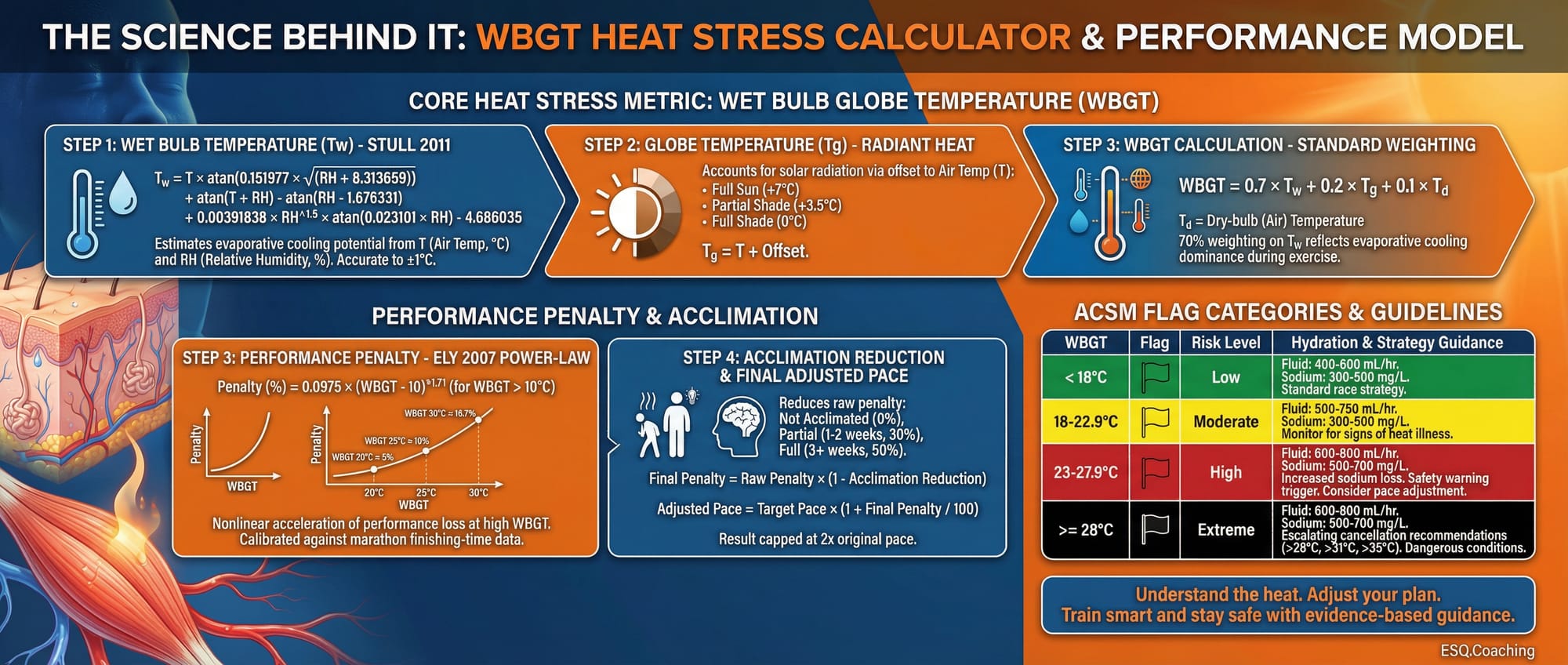
Two neighbors cover adjacent ground. The hot room as recovery deals with passive heat, and a snippet on humid air explains why humidity changes the picture.
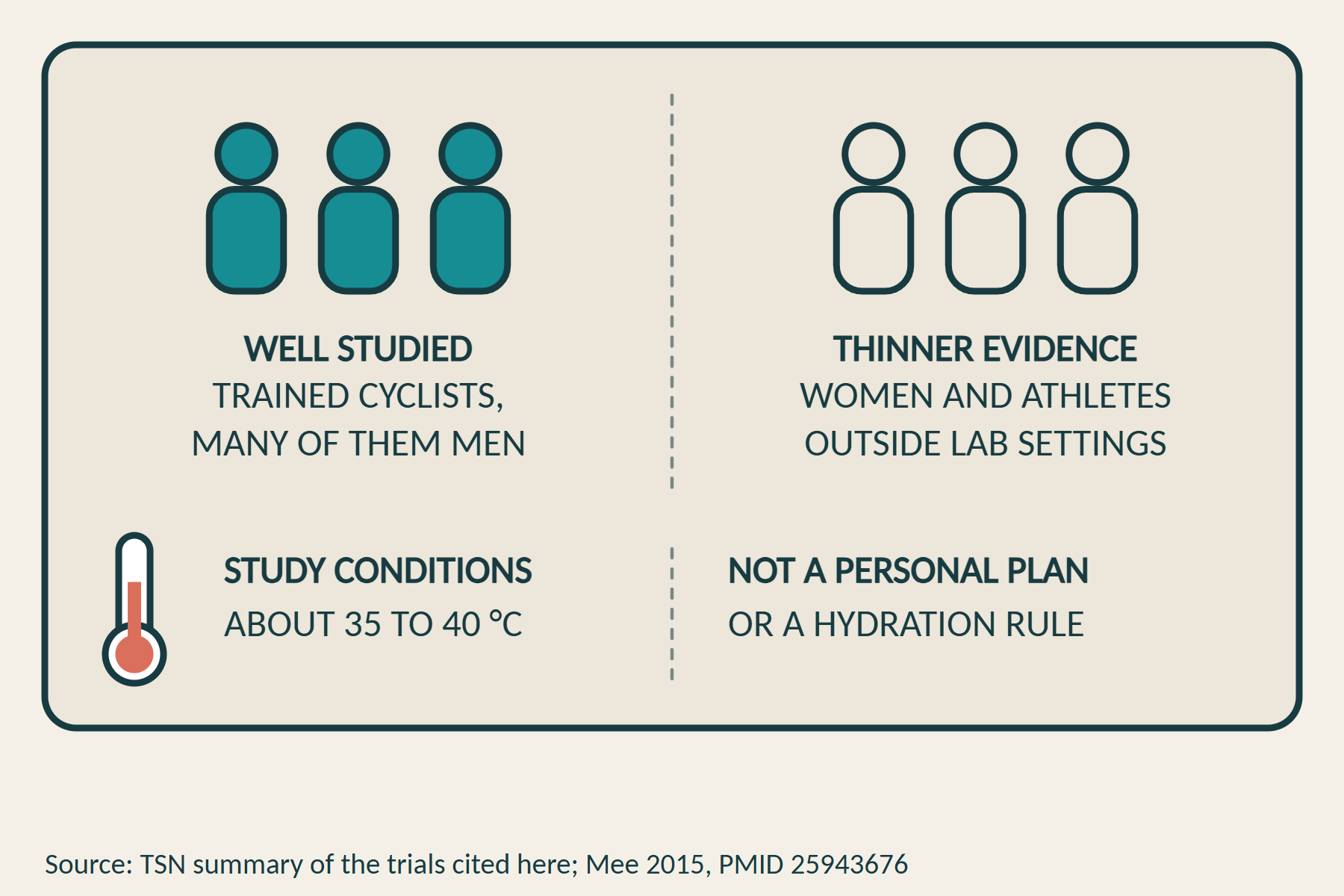
The values reported here describe study conditions and population ranges, not a personal hydration plan. Sweat rate, sodium loss, acclimation, environmental conditions and medical factors vary substantially. Overdrinking can also cause harm.
Every temperature and session length below is what a study used, and none of it is an instruction.
The numbers in this piece are the kind Gradescale computes from your own rides and runs, with the working shown.
The brief
- Ten days of exercise in heat raised hot-condition time-trial work by 8% in trained cyclists. In 12 cyclists, VO2max (maximal oxygen uptake) also rose 8% in 38°C air, while 8 controls training in 13°C air did not change.
- The same block raised cool-condition time-trial work by 6%, and that result is the contested one. VO2max rose 5% and plasma volume 6.5% in those 12 cyclists, yet two later cycling trials found no cool-air gain.
- Moderately trained men adapted heart rate and core temperature within five days. In 10 moderately trained men, five 90-minute sessions in 39.5°C air lowered rectal temperature by 0.3°C and heart rate by 13 beats per minute at the end of a later 90-minute test.
- Skin and sweat glands change locally, while maximal skin blood flow stays the same. In 12 highly trained cyclists, ten days of acclimation strengthened skin vessel and sweating responses to local stimulation, and maximal forearm blood flow was unchanged.
- Five weeks of heat sessions raised hemoglobin mass by 2.4% to 4.0% in elite cyclists. Women gained 4.0% and men 3.5% in one trial, and a heat chamber and a heat suit gave 2.4% and 2.6% in another.
- Two later trials found no cool-air gain from heat training. In 9 trained men, two weeks in about 35°C heat raised hot time-trial performance by 16% but left a 43.4 km cool-air time trial unchanged, and in 21 cyclists a 5.5-week block did no better than normal training.
- Heat adaptations fade fast and return faster. Heart rate and core-temperature gains decayed by 2.3% and 2.6% for every day without heat, and re-acclimation ran 8 to 12 times faster than the decay.
- Women and men may follow different timelines. After five days, peak rectal temperature fell 0.39°C in eight men and 0.07°C in eight women, and the women's cooling appeared only in the ten-day test.
The science at a glance
Foundational Principle 1: Heat adds a thermal cost to every pace, and acclimation lowers that cost
In warm air the gap that normally carries heat away shrinks, so the body leans on sweat evaporation and on sending blood to the skin, and both compete with the working muscle for a finite circulation.
Thomas Mortelmans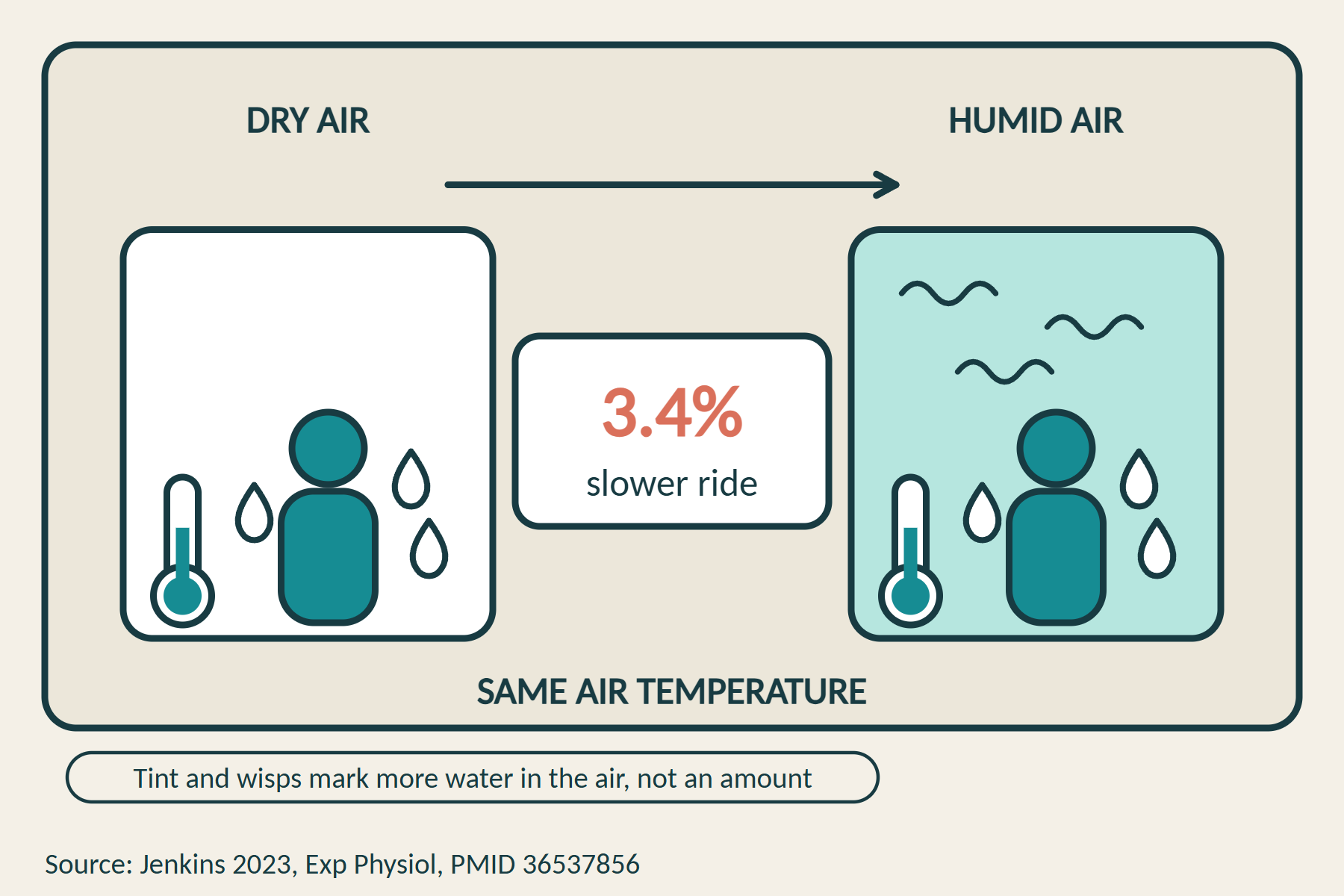
In eight subjects exercising to exhaustion at 60% of VO2max in 40°C air, 9 to 12 days of repeated sessions lengthened average endurance from 48 to 80 minutes, with a slower rise in heart rate and core temperature and more sweating.
Exhaustion came at a core temperature of about 39.7°C, and cardiac output and leg blood flow had not fallen by then. The classic reading is that high core temperature, and not circulatory failure, ends the effort.
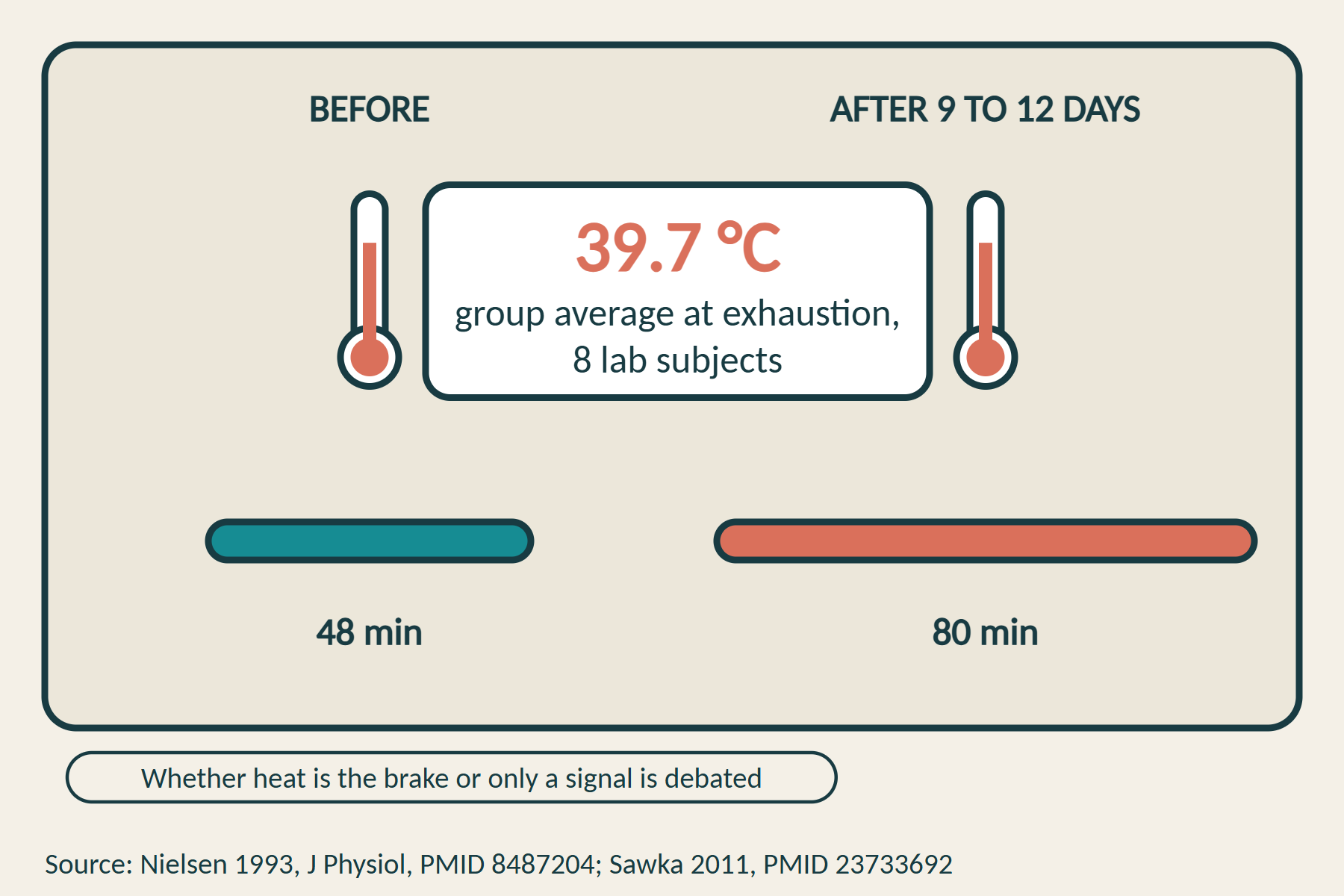
That reading is now contested, since the idea that high core temperature is the critical mediator of lost performance has been explicitly questioned in later integrative work.
Scientist's Insight: Acclimation moves the point where a hot effort ends, but whether core temperature is the brake or only the clearest signal of one remains open.
Foundational Principle 2: Blood volume is a structural change that plausibly explains much of the heart's relief
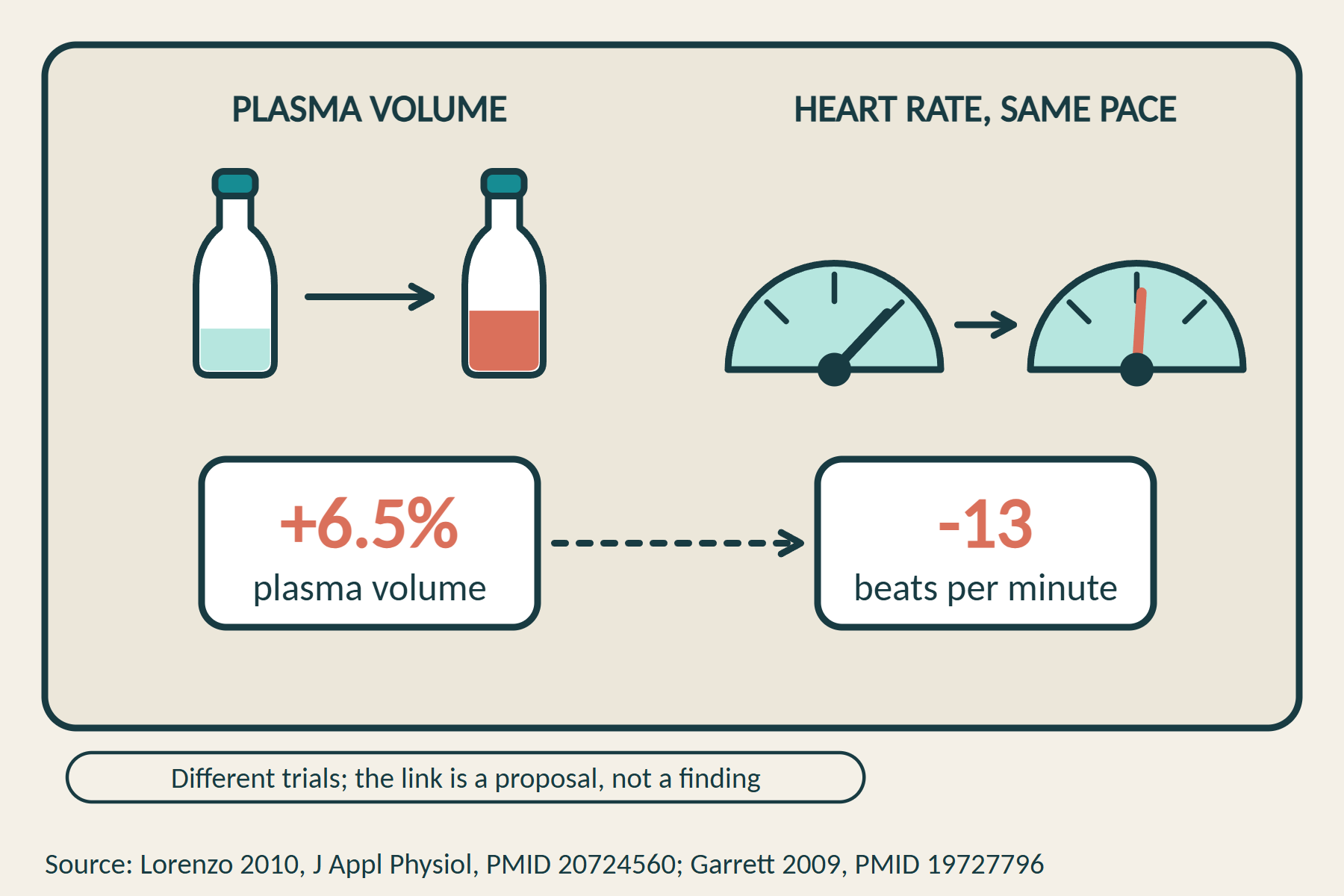
Plasma volume rose by 6.5% after ten days of heat acclimation in 12 trained cyclists, alongside a higher maximal cardiac output.
A larger plasma volume fills the heart more completely between beats, which raises the volume ejected per beat and lets the heart do the same job at a lower rate.
In the older hot-room work, cardiac output rose from 19.6 to 21.4 liters per minute across the acclimation days, and the rise was possibly due to more plasma and a larger stroke volume. The wording is hedged, and the link is best read as a proposal.
Five weeks of heat training in elite cyclists left muscle citrate synthase activity, fiber type and capillary density unchanged, so the adaptation measured in that trial sits in the blood.
Scientist's Insight: Several downstream benefits, from a calmer heart rate to a possible cool-air gain, would follow from a fuller circulation if that proposed link holds.
Foundational Principle 3: Adaptation is a set of systems running on different clocks
Heat acclimation is not a single switch.
In pooled data, five or more days of acclimation were enough to adapt heart rate and core temperature, longer daily exposure helped core temperature, and longer periods helped sweat rate.
The skin changes locally as well. In 12 highly trained cyclists, ten days of acclimation strengthened skin vessel opening and sweating to local stimulation, while maximal forearm blood flow stayed unchanged.
The change lay in how vessels and glands respond, and not in how much blood they can carry.
Hemoglobin mass sits on a longer clock, with gains of 2.4% to 4.0% after five weeks of five weekly 50-minute sessions in elite cyclists.
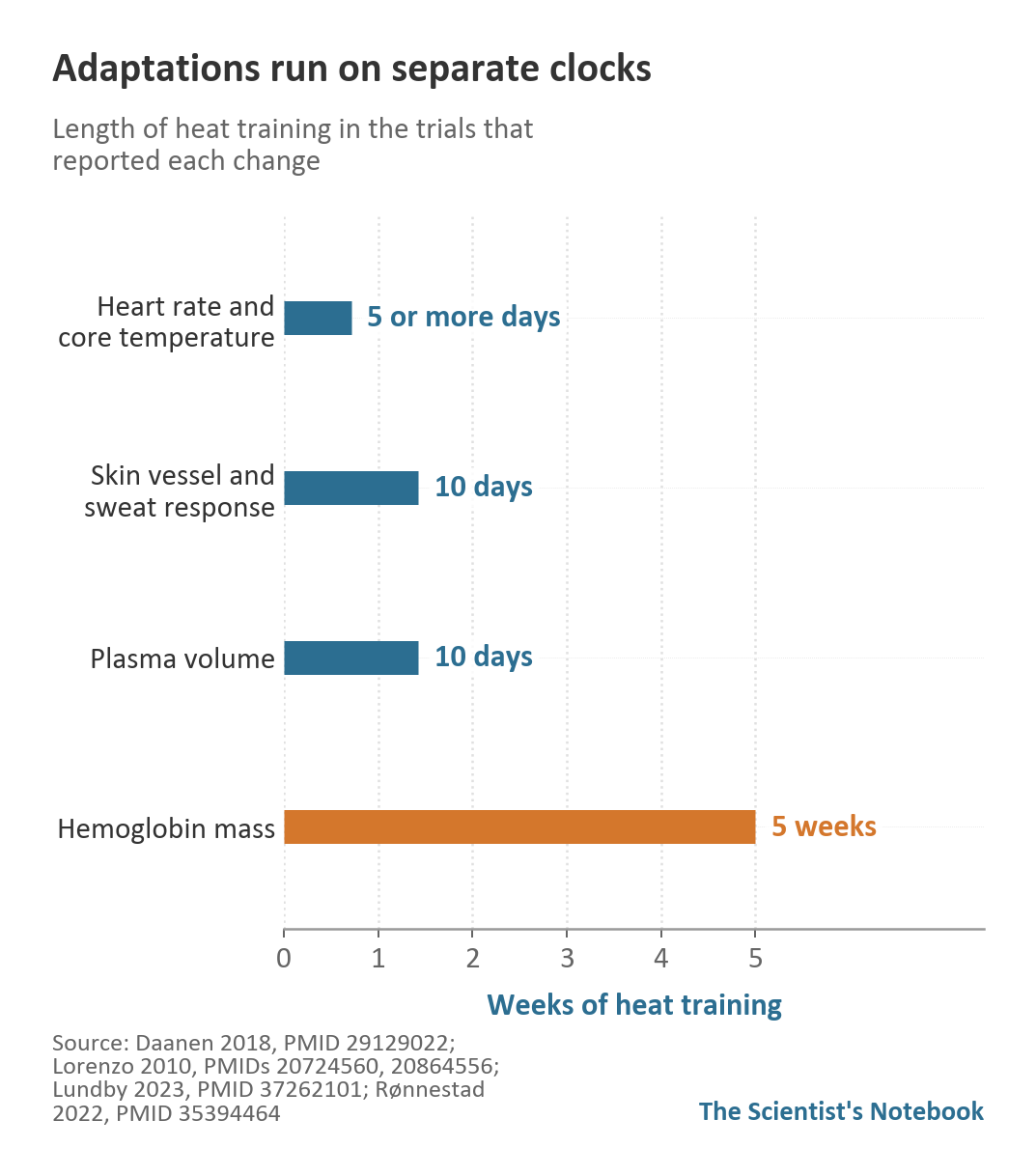
Scientist's Insight: Asking whether an athlete is acclimated hides that heart rate, core temperature, sweating and blood volume finish on different dates.
Reading the signals
Lever 1: How the heat is delivered
The data: In a meta-analysis of 96 articles, the most common duration was 7 to 14 days and the most common method a controlled work rate, and heat adaptation was moderately beneficial for capacity and performance in the heat irrespective of regimen.
A controlled-hyperthermia design holds core temperature at a target instead of holding the workload fixed. It may give faster and more complete adaptation, though that evidence is described as emerging.
On one cellular marker the methods tied. In 24 men, a fixed 50% of VO2peak, a rectal temperature held at 38.5°C and a stepped 38.5°C to 39.0°C protocol all raised white-blood-cell heat shock protein 72 messenger RNA, with no difference between methods.
In elite cyclists, five 50-minute sessions a week for five weeks raised hemoglobin mass 2.6% in a heat suit and 2.4% in a chamber, against a 0.7% fall in controls.
Only the heat suit beat controls significantly on power at 4 mmol/L lactate, with a 3.6% gain against a 0.6% fall, while the chamber's 1.4% did not reach significance.
Where athletes tend to land: Athletes with a hot target event tend to train in conditions that resemble it, which matches the designs behind the clearest heat results.
Athletes with a cool target event tend to look at the chamber and heat-suit trials in elite cyclists under study conditions.
Lever 2: How long the block runs, and how long it lasts
The data: In 10 moderately trained men, five 90-minute sessions at controlled hyperthermia lowered end-of-test rectal temperature by 0.3°C and heart rate by 13 beats per minute, and performance on the test that followed rose by 106 seconds from 746.
Those changes persisted for one week but not two, with seven men retested at two and three weeks.
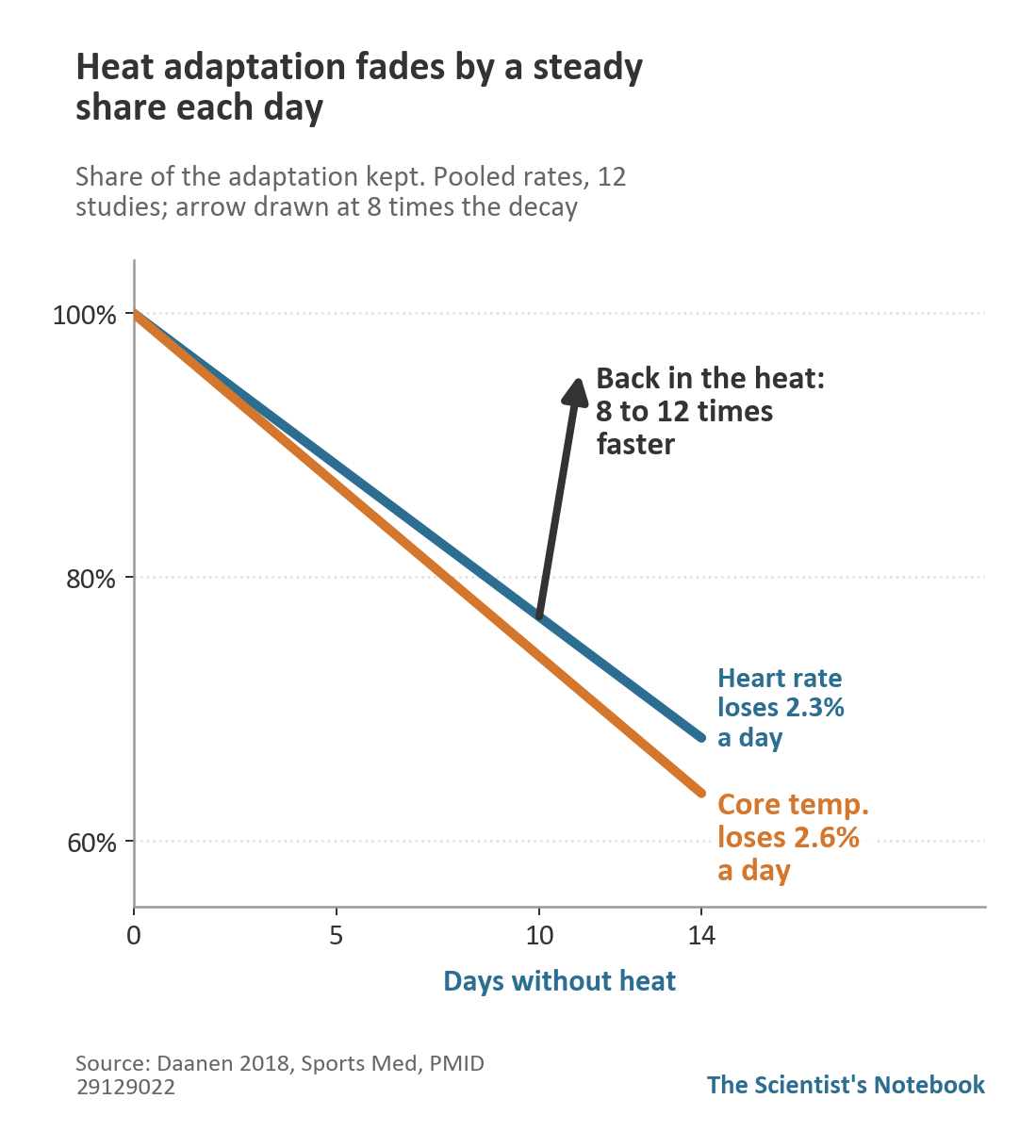
In pooled data on decay, heart rate adaptation faded by 2.3% and core-temperature adaptation by 2.6% for every day without heat, and re-acclimation was 8 to 12 times faster than the decay.
Regimens beyond two weeks gave the largest overall adaptations in a meta-analysis, and the elite-cyclist trials that raised hemoglobin mass ran five weeks.
In the three weeks after that block, three weekly heat-suit sessions went with a 3.3% rise in hemoglobin mass, against 0.8% in athletes who stopped heat sessions, though not significantly more than the 1.6% in controls.
For hot competition, the expert consensus puts one to two weeks of repeated exercise-heat exposure first among preparations.
Where athletes tend to land: Athletes with a hot event soon tend to look at the short-block data, where heart rate and core temperature changed within five days in 10 moderately trained men.
Athletes planning months ahead tend to look at the five-week trials in elite cyclists under study conditions.
Lever 3: Whether the gain travels to cool air
The data: In 12 trained cyclists, ten days of heat acclimation raised VO2max by 5% in 13°C air and time-trial work by 6% (879.8 to 934.7 kJ), while 8 controls training in cool air did not change.
Two cycling trials found no cool-air gain. In 9 trained men, against 9 controls, two weeks of outdoor training in about 35°C heat left VO2max (4.79 vs 4.82 l/min), peak power and a 43.4 km cool-air time trial unchanged.
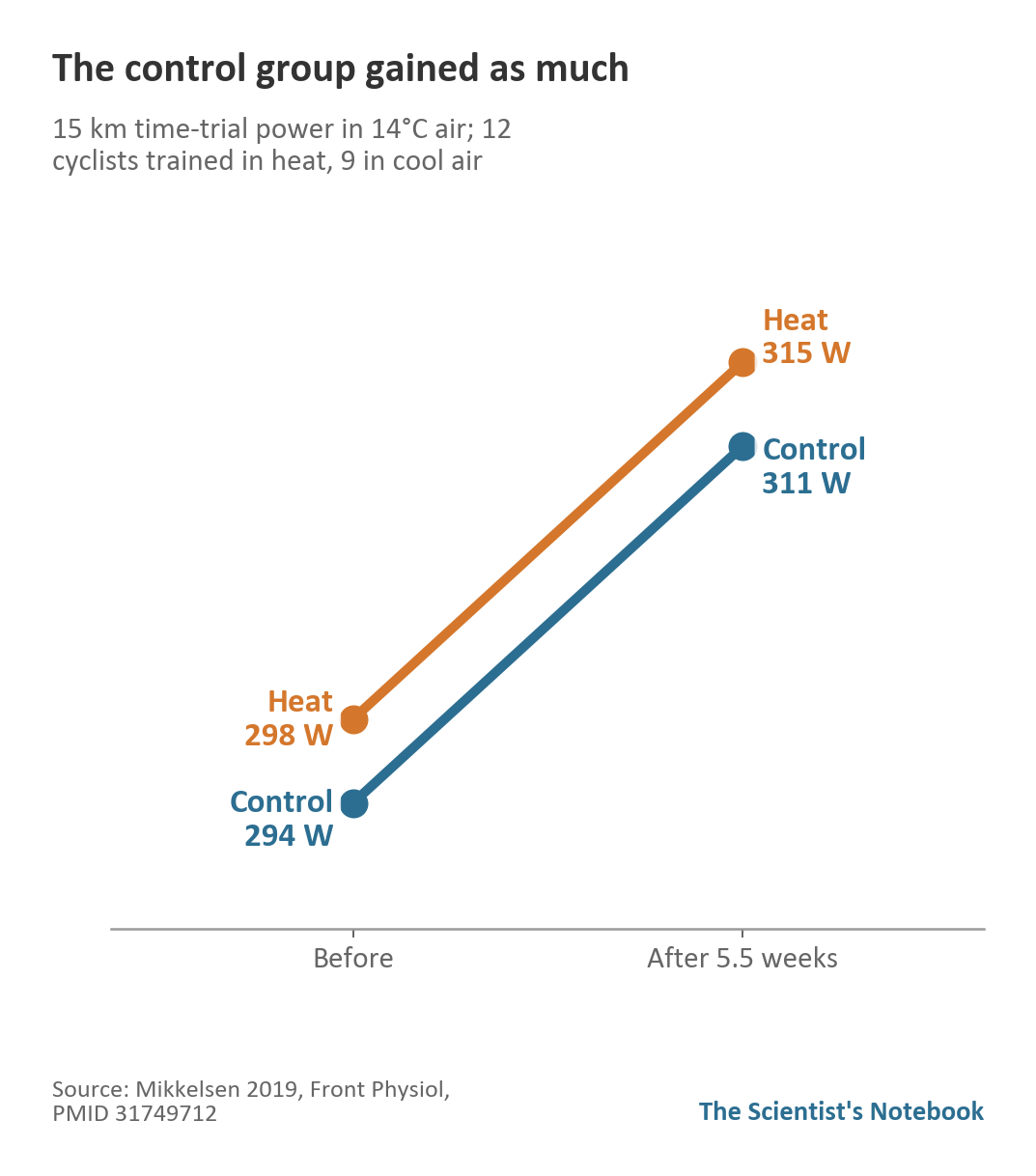
In 12 cyclists, against 9 controls, 5.5 weeks with about 28 one-hour sessions at 40°C left VO2max and peak power unchanged in 14°C air. Time-trial power rose from 298 to 315 W with heat and from 294 to 311 W in controls, so the control group improved just as much.
Five weeks of five weekly 50-minute sessions improved lactate threshold, VO2max and 15-minute power in the heat groups of a trial with 20 women and 27 men, and pooled chamber and suit groups beat controls on a composite performance index, 4.9% against 1.7%.
The pattern does not sort cleanly by length. A 10-day block found a gain and a 5.5-week block found none, and the control group in the longer trial improved on its own.
Where athletes tend to land: Athletes targeting a hot event treat the cool-air question as beside the point, since the heat gains are not in dispute.
Thomas Mortelmans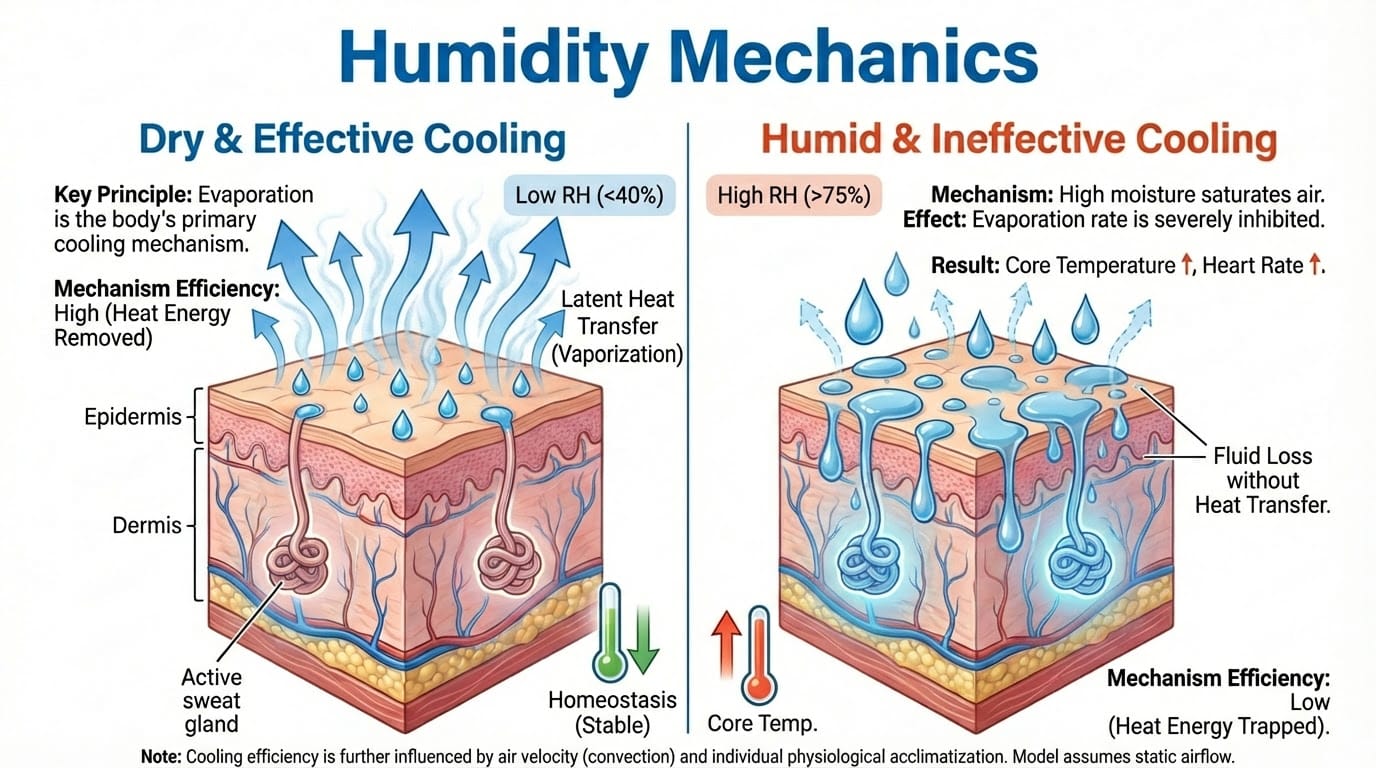
Athletes targeting a cool event split, with some reading the positive trials as a reason to add heat blocks and others reading the null trials as a reason to call any cool-air gain unproven.
Method and a worked example
The trials share a core design, and its details explain much of the disagreement over transfer.
Method
- Participants are tested before the block in standardized conditions, often in both cool and hot air.
- A supervised heat block follows: submaximal exercise at 50% to 60% of VO2max in air near 40°C, in sessions of 45 to 90 minutes on consecutive days, or with core temperature held at a target such as 38.5°C.
- A control group performs matched exercise in cool air, often near 13°C, which separates the effect of heat from the effect of training itself.
- The same tests are repeated after the block, in cool air for the transfer question and in hot air for the acclimation question, with plasma volume or hemoglobin mass measured where the question concerns blood.
- Retests after a gap of one, two and three weeks show how fast the adaptations decay, and a second short block shows how fast they return.
A composite case
This athlete is invented, assembled from the patterns above. The block is not a plan.
A recreational cyclist preparing for a warm-weather event starts a two-week block of 60-minute indoor sessions in a heated room.
The first three sessions feel worse than the same ride in cool air, with a high heart rate and a sense of dread before each one.
Around day five the same power sits several beats below the day-one heart rate, and sweating starts sooner.
On day seven headache and nausea end a session early. Both are warning signs of heat illness, so the athlete stops and cools down. The curve is not a smooth ramp.
A time trial on day thirteen is faster than baseline, but repeat tests in cool air differ from one another by nearly as much, so the gain cannot be assigned to the heat.
A nine-day work trip removes the athlete from the heat, and a few short sessions on return bring the heart rate back near its day-twelve level.
Four weeks after the block began, the warm-weather event costs less heart rate than the same pace did before the block, while cool-weather rides that month are no faster than usual, so the payoff arrives late and only in the heat.
Where this leaves us
Heat acclimation is one of the better-documented adaptations in endurance physiology, and for a hot event the evidence is consistent.
The cool-weather offer is the part I find more interesting. It rests on a plausible mechanism, a fuller circulation and more hemoglobin, and on trials that point in two directions.
The tidy answer is that it may depend on block length, on whether the athletes were elite, on whether heat replaced normal training or came on top of it, and on how performance was measured. I would not call that settled.
Women, and athletes outside elite and supervised settings, are where I'd expect the next few trials to change the picture.
Best regards, Dr. Thomas Mortelmans
Limits of Application: Most trials enrolled small groups of trained or elite cyclists, many of them men, in laboratory or supervised settings, and several compared heat with a control group of eight or nine.
Normal training alone can produce gains of a similar size, as one control group improved as much as the heat group.
Heat exposure carries a risk of heat illness. Headache, nausea, dizziness or unusual weakness are early warning signs, and confusion, fainting or a very high body temperature are medical emergencies. Nothing here is medical or coaching advice, and tolerance of heat differs with fitness, health, medication, recent illness and acclimation history.
References
- Nielsen B, et al. Human circulatory and thermoregulatory adaptations with heat acclimation and exercise in a hot, dry environment. J Physiol. 1993. PMID 8487204. In eight subjects acclimated for 9 to 12 days, endurance rose from 48 to 80 minutes, and exhaustion came at a core temperature of 39.7°C.
- Sawka MN, et al. Integrated physiological mechanisms of exercise performance, adaptation, and maladaptation to heat stress. Compr Physiol. 2011. PMID 23733692. An integrative review of heat acclimation and heat tolerance that questions the traditional notion that high core temperature is the critical mediator of lost performance.
- Lorenzo S, et al. Heat acclimation improves exercise performance. J Appl Physiol. 2010. PMID 20724560. In 12 trained cyclists, ten days of heat acclimation raised VO2max by 5% and time-trial work by 6% in cool air, against 8 unchanged controls.
- Lorenzo S, Minson CT. Heat acclimation improves cutaneous vascular function and sweating in trained cyclists. J Appl Physiol. 2010. PMID 20864556. In 12 highly trained cyclists, against 8 controls, ten days of acclimation strengthened skin vessel and sweating responses to local stimulation without changing maximal forearm blood flow.
- Périard JD, et al. Adaptations and mechanisms of human heat acclimation: applications for competitive athletes and sports. Scand J Med Sci Sports. 2015. PMID 25943654. A review of heat acclimation adaptations that reports effects depending on intensity, duration, frequency and number of exposures, with emerging evidence favoring controlled hyperthermia.
- Tyler CJ, et al. The effects of heat adaptation on physiology, perception and exercise performance in the heat: a meta-analysis. Sports Med. 2016. PMID 27106556. Pooled 96 articles and found heat adaptation moderately beneficial for performance in the heat irrespective of regimen, with the largest adaptations after regimens longer than 14 days.
- Garrett AT, et al. Induction and decay of short-term heat acclimation. Eur J Appl Physiol. 2009. PMID 19727796. In 10 moderately trained men, five days of controlled hyperthermia lowered rectal temperature and heart rate, and the changes persisted one week but not two.
- Daanen HAM, et al. Heat Acclimation Decay and Re-Induction: A Systematic Review and Meta-Analysis. Sports Med. 2018. PMID 29129022. Pooled 12 studies and found heart rate and core-temperature adaptations decayed by 2.3% and 2.6% per day, with re-acclimation 8 to 12 times faster.
- Mee JA, et al. A comparison of males and females' temporal patterning to short- and long-term heat acclimation. Scand J Med Sci Sports. 2015. PMID 25943676. In eight men and eight women, men adapted after five days of heat, while women showed thermoregulatory and cardiovascular stability only after ten.
- Gibson OR, et al. Isothermic and fixed-intensity heat acclimation methods elicit equal increases in Hsp72 mRNA. Scand J Med Sci Sports. 2015. PMID 25943677. In 24 men, fixed-intensity and two isothermic protocols raised heat shock protein 72 messenger RNA equally.
- Lundby C, et al. Hematological, skeletal muscle fiber, and exercise performance adaptations to heat training in elite female and male cyclists. J Appl Physiol. 2023. PMID 37262101. In a trial of 20 women and 27 men randomized to heat training or control, five weeks of heat training raised hemoglobin mass by 4.0% and 3.5% and improved thermoneutral performance, with muscle properties unchanged.
- Rønnestad BR, et al. Heat Training Efficiently Increases and Maintains Hemoglobin Mass and Temperate Endurance Performance in Elite Cyclists. Med Sci Sports Exerc. 2022. PMID 35394464. Heat chamber and heat suit sessions raised hemoglobin mass by 2.4% and 2.6% in elite cyclists, and three weekly suit sessions went with a 3.3% rise.
- Karlsen A, et al. Heat acclimatization does not improve VO2max or cycling performance in a cool climate in trained cyclists. Scand J Med Sci Sports. 2015. PMID 25943678. In 9 trained men, against 9 controls, two weeks of training in about 35°C heat improved hot time trials by 16% and left VO2max and cool-air time trials unchanged.
- Mikkelsen CJ, et al. Prolonged Heat Acclimation and Aerobic Performance in Endurance Trained Athletes. Front Physiol. 2019. PMID 31749712. In 12 cyclists, 5.5 weeks of heat training left cool-air VO2max unchanged and improved time trials no more than in 9 controls.
- Racinais S, et al. Consensus recommendations on training and competing in the heat. Br J Sports Med. 2015. PMID 26069301. An expert consensus that names heat acclimatization over one to two weeks of repeated exercise-heat exposure as the main intervention for hot-weather performance.
If you have 60 seconds, I would value your anonymous feedback. You can share it here.
Health disclaimer
This entry summarizes what studies found about training in the heat. It describes research, not a plan for you. Studies mostly tested trained or elite cyclists in supervised settings, and every temperature and session length is what a study used, not an instruction. Heat can cause illness, and tolerance varies between people, so this entry is not a protocol for heat exposure or a way to judge your own tolerance. Not medical advice.
Keep going
Gradescale turns your training history into the models in this piece: power-duration, load balance, and readiness, each with its sources.
Training plans built on the same evidence base:
Thomas MortelmansJoin our Discord community:
Thomas Mortelmans