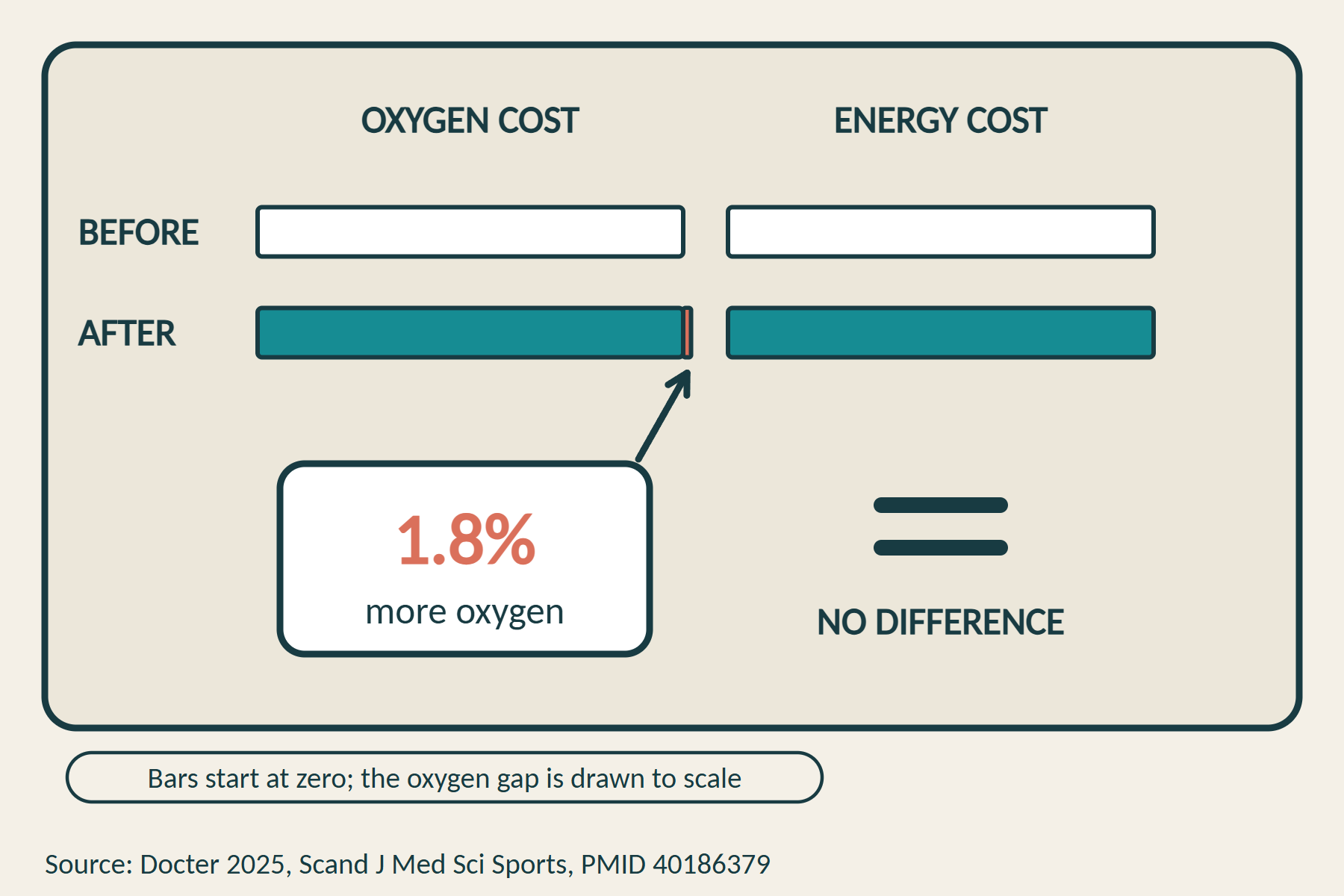
Snippet #046: In Women, Oxygen Cost Rose After Intervals but Energy Cost Held Steady
After an interval session, running cost more oxygen but not more energy.
Running economy can be priced in oxygen or energy, and the energy price uses RER, the ratio of carbon dioxide out to oxygen in.
In endurance-trained women, oxygen cost at a steady test pace was 1.8% higher after five intervals of four minutes at 80% of maximal speed (269 to 274 mL/kg/km). Energy cost did not differ: 1.33 versus 1.34 kcal/kg/km (Docter et al. 2025).
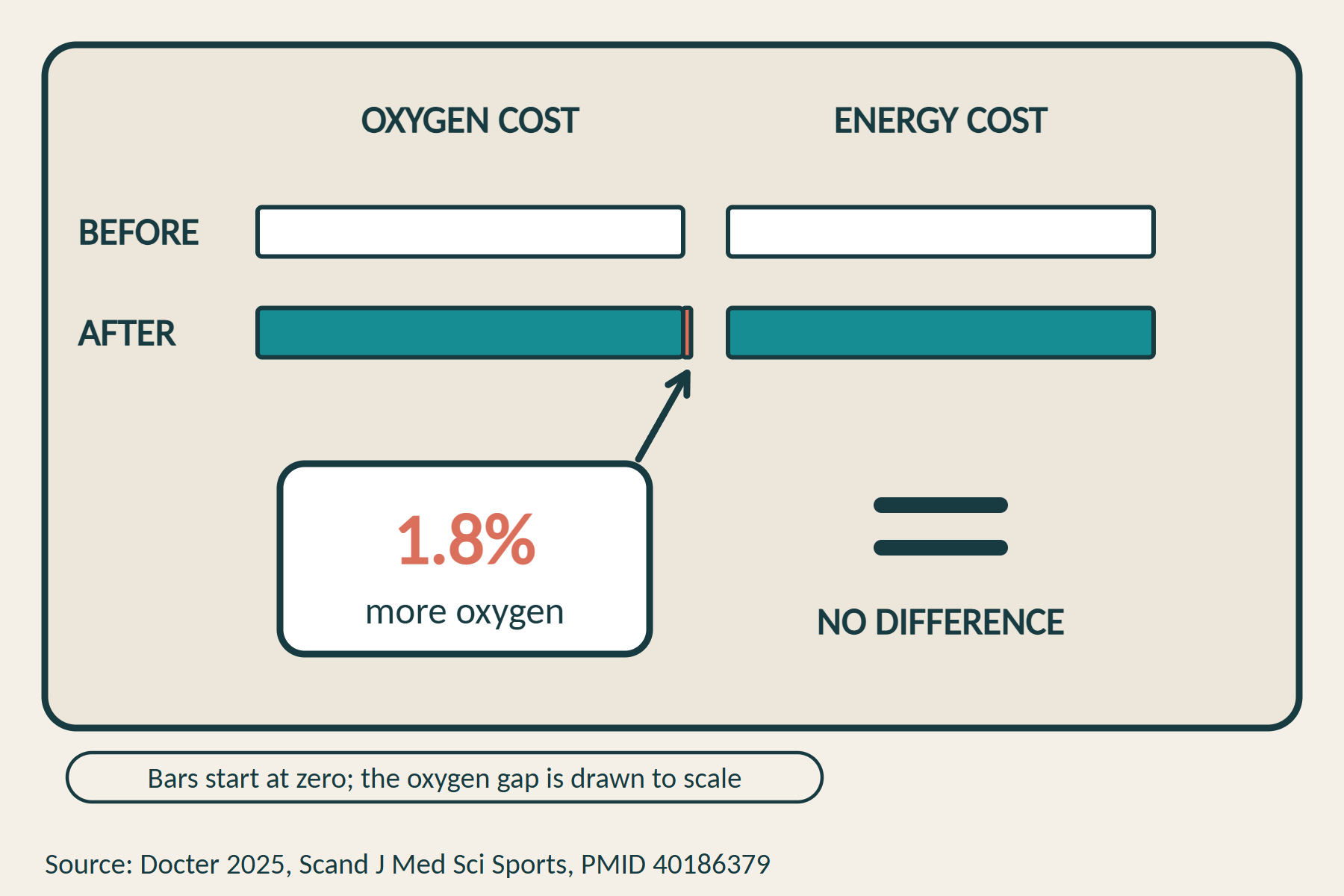
At the test pace, RER fell from 0.92 to 0.86, and the two prices of one run parted ways.
Whether intervals cost these women economy depended on the unit. The authors call the practical relevance of the oxygen rise questionable.
After an easy hour at 45 to 55% of maximal speed, neither price differed.
This is one laboratory study of naturally menstruating endurance-trained women (16 analyzed for the intervals), so it says nothing about men, longer sessions or race pace.
Each woman was tested at 60% of her maximal speed (mean 8.5 km/h) on a 5% incline, and menstrual cycle phase did not confound energy cost.
If you have 60 seconds, I would value your anonymous feedback. You can share it here.
Health disclaimer
This summarizes one small laboratory study of women running on a treadmill. It cannot say how any one runner's economy changes after training, and it is not a training recommendation. Not medical advice.
 Thomas Mortelmans
 Thomas Mortelmans
Related reading
Thomas Mortelmans
Related reading
Free calculator
Keep going
These are the numbers Gradescale computes from your own rides and runs, with the working shown.
Training plans built on the same evidence base:
Thomas MortelmansJoin our Discord community:
Thomas Mortelmans