Snippet #041: How Sauna Heat Expands Blood Plasma and Supports Endurance
Repeated post-exercise heat exposure expands plasma volume, the fluid portion of blood that carries red cells and nutrients.
A crossover trial in competitive runners found three weeks of post-training sauna sessions raised plasma volume by 7.1%, a change that tracked closely with a 32% improvement in run time to exhaustion (Scoon et al. 2007).
Repeated heat appears to prompt the kidneys to retain more fluid and protein, progressively inflating the blood's liquid compartment.
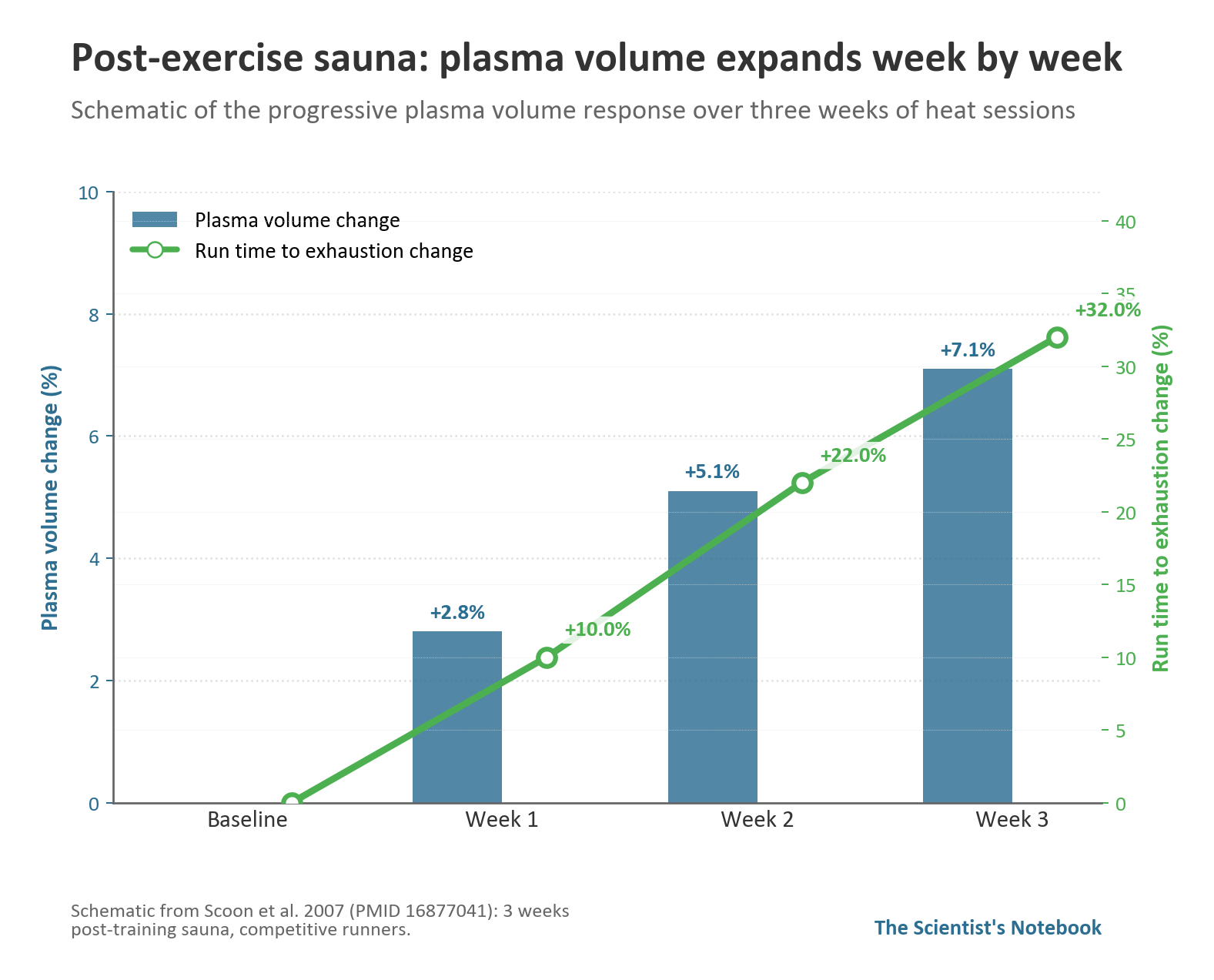
A larger plasma volume gives the cardiovascular system more fluid to distribute, which studies associate with steadier output during sustained effort and improved heat dissipation.
Researchers have noted modest endurance gains in cool conditions following heat acclimation, suggesting the blood-volume adaptation is not confined to hot environments.
The adaptation decays within weeks of stopping heat exposure, and the evidence currently rests on small trials in mostly male athletes. The sessions carry meaningful hydration demands, which makes fluid replacement a relevant safety consideration.
---
If you have 60 seconds, I would value your anonymous feedback. You can share it here.
---
### Health disclaimer
This post discusses endurance-training science for educational purposes. It is not medical advice, not a diagnosis, and not a substitute for clinical care. Individual response to training, sleep deprivation, and multi-day exertion varies substantially, and what applies to a research cohort or a world-class athlete may not apply to you. > Consult a qualified physician, sports medicine specialist, or registered dietitian before changing your training, fuelling, or sleep strategy if you have a cardiovascular, metabolic, psychiatric, or sleep-related condition; are recovering from injury or illness; are pregnant; are on medication that affects heart rate, hydration, glucose regulation, or sleep; or have concerns about exercise tolerance. > Ultra-endurance events impose real physiological and psychological loads. Persistent chest pain, fainting, acute confusion beyond the predictable late-race window, severe dehydration, sustained loss of coordination, or any mental-health symptoms that outlast the immediate post-event dip warrant professional care and are not signals to push through. > No outcome is guaranteed. The protocols, anchors, and case material in this post are descriptive, drawn from peer-reviewed evidence and a guest contributor's lived experience, and should be treated as inputs to an informed conversation with your own coach and clinicians, not as prescriptions.
 Thomas Mortelmans
Related reading
Thomas Mortelmans
Related reading
Keep going
Every number in this piece is one you can compute from your own rides and runs, with the formula and the source shown alongside it.
Training plans built on the same evidence base:
Thomas MortelmansJoin our Discord community:
Thomas Mortelmans