Entry #048: One Dial, Two Steady Settings: How Carbohydrate, Protein and Fat Move Across a Training Week
Carbohydrate is the nutrient that changes most across a training week. The position stands describe daily intakes from 3 to 12 grams per kilogram of body weight, a fourfold spread, while protein and fat stay in much narrower bands.
That asymmetry is what this entry is about.
Athletes hear one daily number, such as "about 6 grams of carbohydrate per kilogram," and apply it to every day. A training week is uneven.
A rest day, a 60-minute easy ride and a five-hour long ride cost the body very different amounts of fuel, and the store those days draw on is small: only a few hundred grams of carbohydrate are held as glycogen (the stored form of carbohydrate in muscle and liver).
A flat number ends up too high on some days and too low on others.
Protein and fat behave differently. In the position stands, protein moves within a much narrower band, so the interesting question becomes how the daily total is spread across meals.
Fat fills the energy that carbohydrate and protein leave open, and the informative evidence concerns what happens at its extremes, very low and very high.
I'll cover four things. The daily carbohydrate ranges that the American College of Sports Medicine (ACSM) reports for light, moderate and heavy training come first.
Next comes how much protein the ACSM and the International Society of Sports Nutrition (ISSN) describe and in what pattern across the day. Then I look at what fat does as the remaining energy.
Last, I look at how carbohydrate taken during a session, counted in grams per hour, runs into the limits of the gut. Throughout, the guidance is reported as what each body recommends, not as an instruction to anyone.
Recovery nutrition after a session, fasted training, fiber, hydration and sodium, race-week carbohydrate loading, and nutrition for changing body composition each have their own posts, so they stay out of this one.
Eating too little for the work done, known as low energy availability, is a separate topic that this entry leaves aside.
The brief
- Carbohydrate is the nutrient that moves most across a training week. The position stands describe 3 to 12 grams per kilogram per day, while protein and fat move far less.
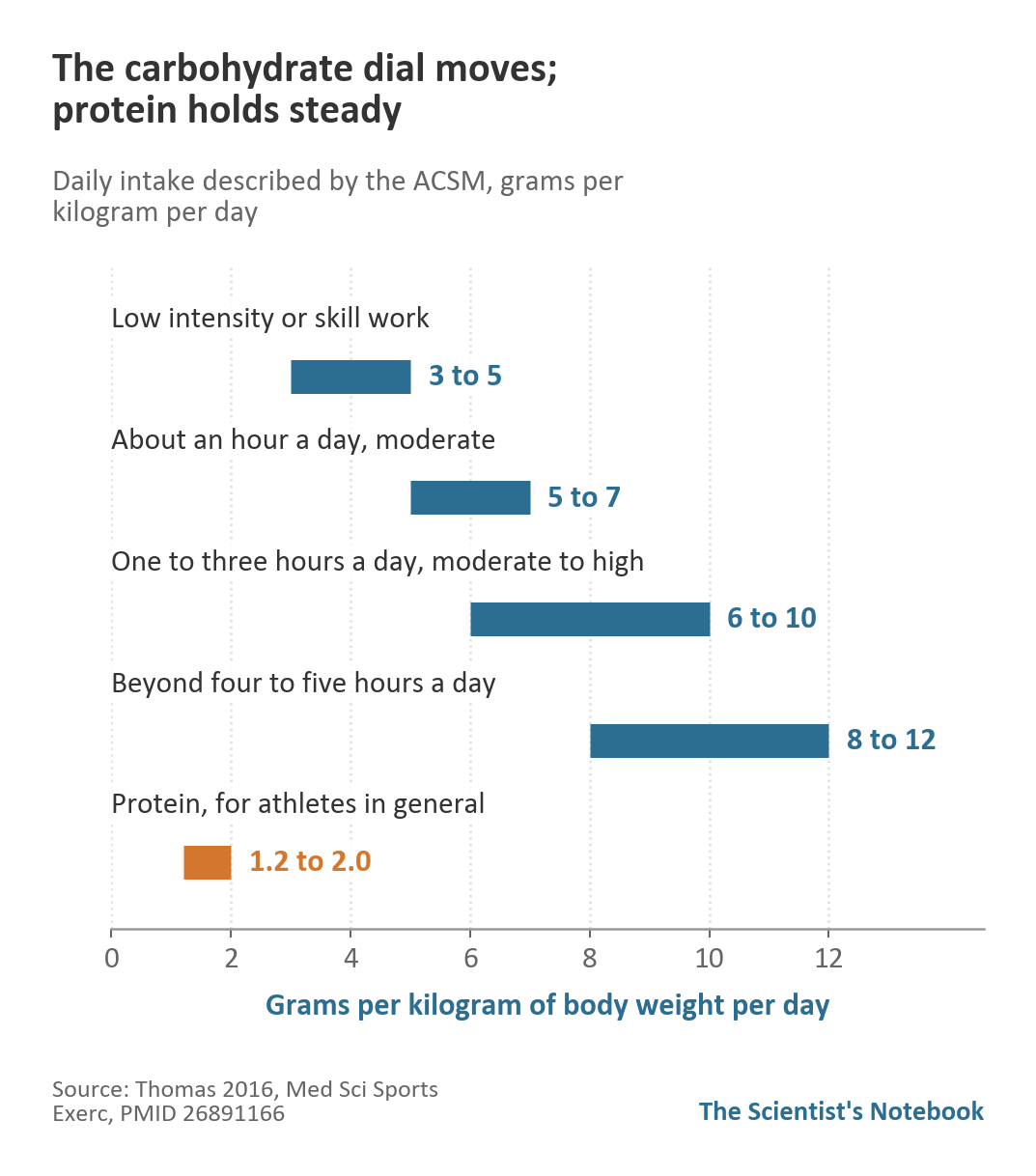
- The daily carbohydrate bands are tied to the hours and intensity of training, not to the calendar. They run from 3 to 5 grams per kilogram for low-intensity days to 8 to 12 beyond four to five hours a day at moderate to high intensity.
- Glycogen is a small tank, so the day's work sets how much carbohydrate is drawn on. Fat cannot keep pace at race-like intensity.
- Protein totals are described as 1.2 to 2.0 grams per kilogram per day. The ACSM places harder or new training toward the top of that band instead of one static target.
- Spreading protein in portions of 20 to 40 grams every three to four hours is the pattern the ISSN describes. In trained men after resistance exercise, four 20-gram portions produced more muscle protein synthesis than eight 10-gram or two 40-gram portions.
- Fat is the energy that remains once carbohydrate and protein are set. The ACSM describes 20 to 35 percent of energy for most athletes.
- Both ends of the fat range show costs in small studies. Very low carbohydrate eating raised the oxygen cost of race walking by 5 to 8 percent, and endurance time ran 14 percent longer on 31 percent fat than on 16 percent.
- For endurance exercise of one to 2.5 hours, guidance describes 30 to 60 grams of carbohydrate per hour, up to 90 beyond 2.5 to 3 hours, but gut tolerance varies widely. A high-carbohydrate diet plus gut training had small and uneven effects in one study of 37 athletes.
The science at a glance
Foundational Principle 1: Carbohydrate need follows the work
Muscle and liver hold only a few hundred grams of glycogen, and hard or long sessions draw it down quickly.
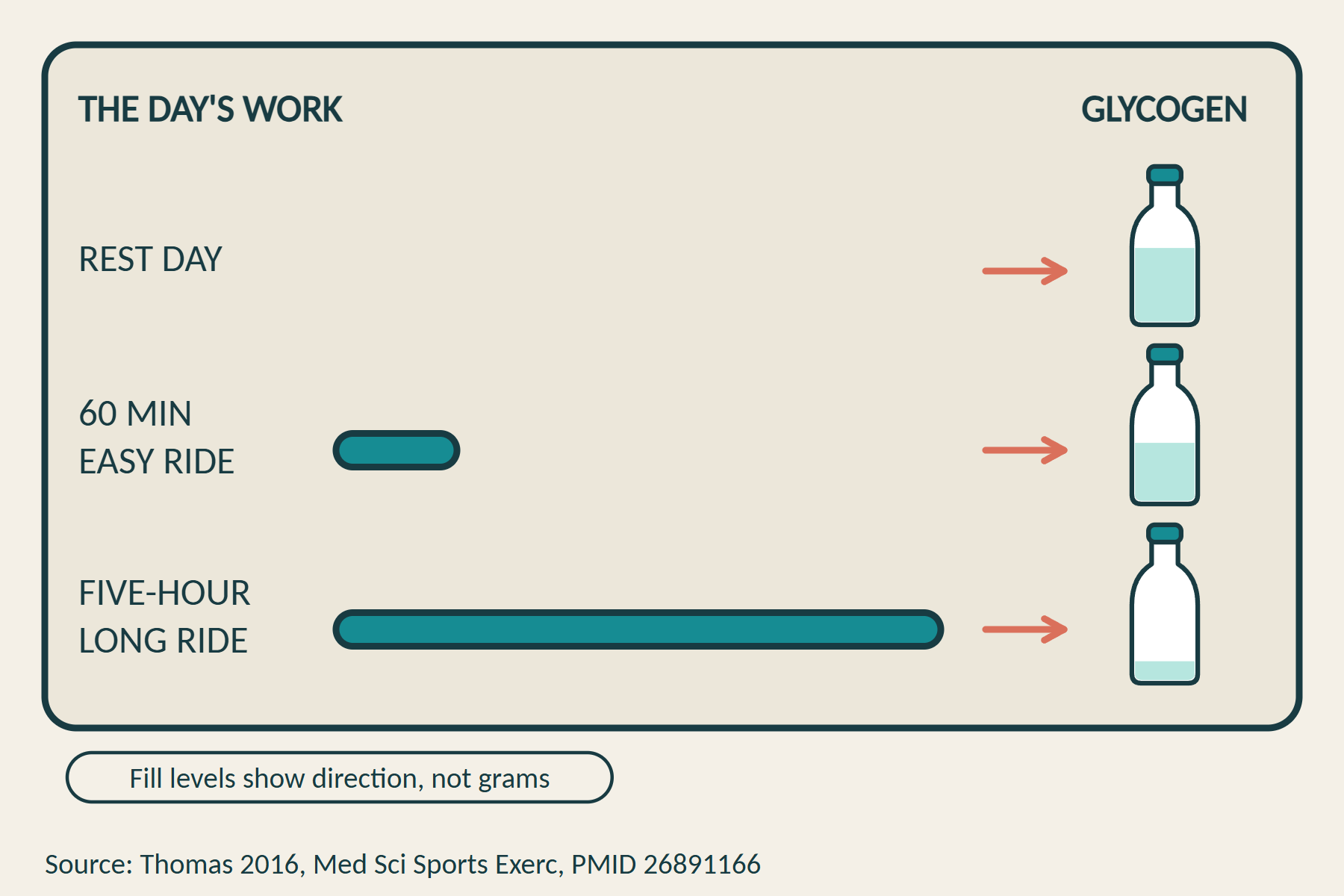
Fat supplies much of the energy at low intensity, but at race-like intensity the body leans on carbohydrate, so the daily need rises with the hours and intensity of the day's work.
 Thomas Mortelmans
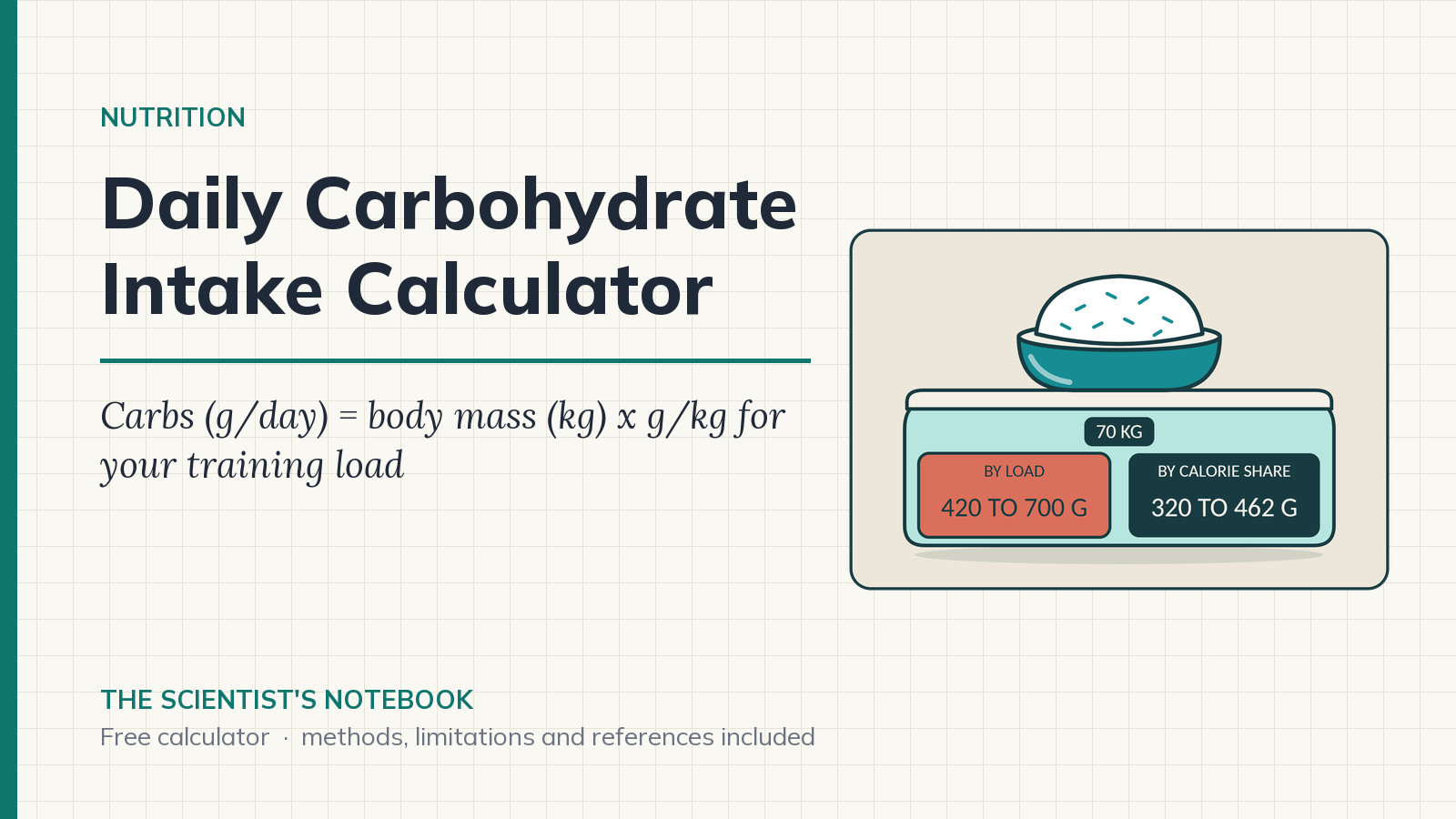
That is the logic behind the position-stand bands, which run from 3 to 5 grams per kilogram on low-intensity days to 8 to 12 grams on days of more than four to five hours at moderate to high intensity.
Carbohydrate periodization, summarized as "fuel for the work required," extends the idea by matching availability to the upcoming session.
The glycogen threshold hypothesis proposes that starting some sessions with lower glycogen may strengthen certain adaptation signals, but only within a window that still lets the session be completed.
Scientist's Insight: Low-glycogen sessions raised adaptation signals in roughly three of four studies reviewed, yet performance improved in only about a third of the studies measuring it, so a stronger signal has not reliably become a faster athlete.
Foundational Principle 2: Muscle responds to protein in portions, and the portion has a ceiling
Muscle protein synthesis (the rate at which the body builds new muscle protein) rises with the amount of protein eaten, then levels off.
After leg resistance exercise in six young men, about 20 grams of egg protein produced the maximal response, and the surplus above that was burned rather than built into tissue.
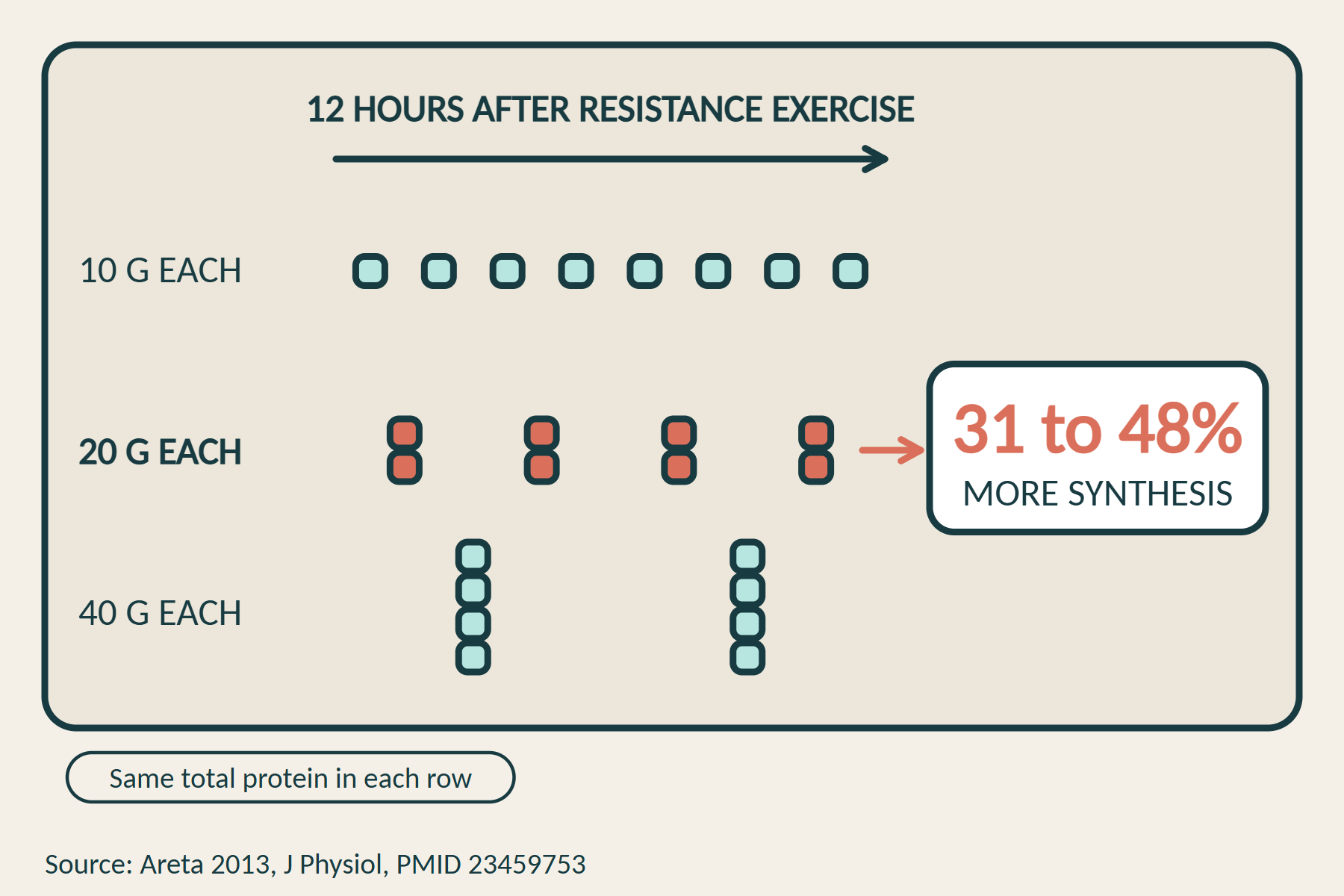
Spreading intake follows from the same ceiling: over 12 hours after resistance exercise, four portions of 20 grams produced 31 to 48 percent more muscle protein synthesis than eight portions of 10 grams or two portions of 40 grams.
For endurance athletes the daily total sits above the sedentary level: after a 20-kilometer run, a recommended intake of about 1.8 grams per kilogram per day was estimated in six endurance-trained men, against 0.8 grams for the general adult recommendation.
Scientist's Insight: Nearly all of the per-portion data come from resistance exercise in young men, so the 20 to 40 gram figures for endurance athletes are borrowed from a different kind of training rather than measured in it.
Foundational Principle 3: Fat is the flexible remainder, and the extremes cost something
Carbohydrate, protein and fat share one energy budget.
Once carbohydrate and protein are set by the day's work, fat fills what remains, which is why the ACSM describes fat as 20 to 35 percent of energy for most athletes rather than as a target in its own right.
The extremes are informative. Among 13 world-class male race walkers, the seven given five to six days of very low carbohydrate, high fat eating burned more than twice as much fat during exercise.
Yet their oxygen cost at race speeds rose by 5 to 8 percent, and a day of carbohydrate restoration did not reverse the drop in 10,000-meter performance.
At the other end, trained runners lasted 14 percent longer in an endurance run on 31 percent of energy from fat than on 16 percent, four weeks each, although they ate 19 percent fewer calories on the lower-fat diet, which tangles the two effects together.
Scientist's Insight: A higher fat-burning rate is not the same as a cheaper way to move at race speed, because the extra oxygen cost showed up in the same athletes whose fat burning had more than doubled.
Reading the signals
Lever 1: Daily carbohydrate by day type
The data: The ACSM bands, in grams per kilogram per day, are 3 to 5 for low-intensity or skill-based training, 5 to 7 for about an hour a day of moderate exercise, and 6 to 10 for one to three hours a day at moderate to high intensity.
The fourth band is 8 to 12 beyond four to five hours at that intensity. For a 70-kilogram athlete that is 210 to 350 grams at the light end and 560 to 840 grams at the top, and 100 grams of carbohydrate is about two cups of cooked rice.
Timing carries information as well as the total: in 21 triathletes eating the same 6 grams per kilogram daily, arranging when carbohydrate fell around sessions was followed, over three weeks, by a 2.9 percent faster 10-kilometer run against 0.1 percent in the group that kept carbohydrate high around every session.
Where athletes tend to land: In the periodized approaches described in the review literature, rest and easy days sit in the lower bands, ordinary days in the middle band, and long or hard days in the upper bands, with intake rising ahead of the key session.
Where reduced-carbohydrate sessions are used at all, they make up roughly 30 to 50 percent of sessions in the train-low studies, with the hardest sessions kept at high availability.
Lever 2: Protein amount and distribution
The data: The ACSM describes 1.2 to 2.0 grams per kilogram per day for athletes, higher for short spells of intensified training, and the ISSN 1.4 to 2.0 for most exercising people, with 20 to 40 grams per portion, about 0.25 grams per kilogram, every three to four hours.
The estimate of 1.8 grams per kilogram for endurance athletes came from six men on a single high-volume day, which is a small sample and a short window.
Where athletes tend to land: A 70-kilogram athlete at 1.6 grams per kilogram takes in 112 grams a day, which across four portions is 28 grams each, inside the described window and roughly the protein in 90 grams of cooked chicken breast.
Between a rest day and a long day the protein line moves only within that narrower band, while the carbohydrate beside it moves by up to a factor of four.
Lever 3: Carbohydrate during sessions and gut tolerance
The data: For competition or key sessions of one to 2.5 hours of endurance exercise, the guidance describes 30 to 60 grams of carbohydrate per hour, and beyond 2.5 to 3 hours up to 90 grams per hour from mixtures that use different intestinal transporters (glucose and fructose, which are absorbed through separate routes).
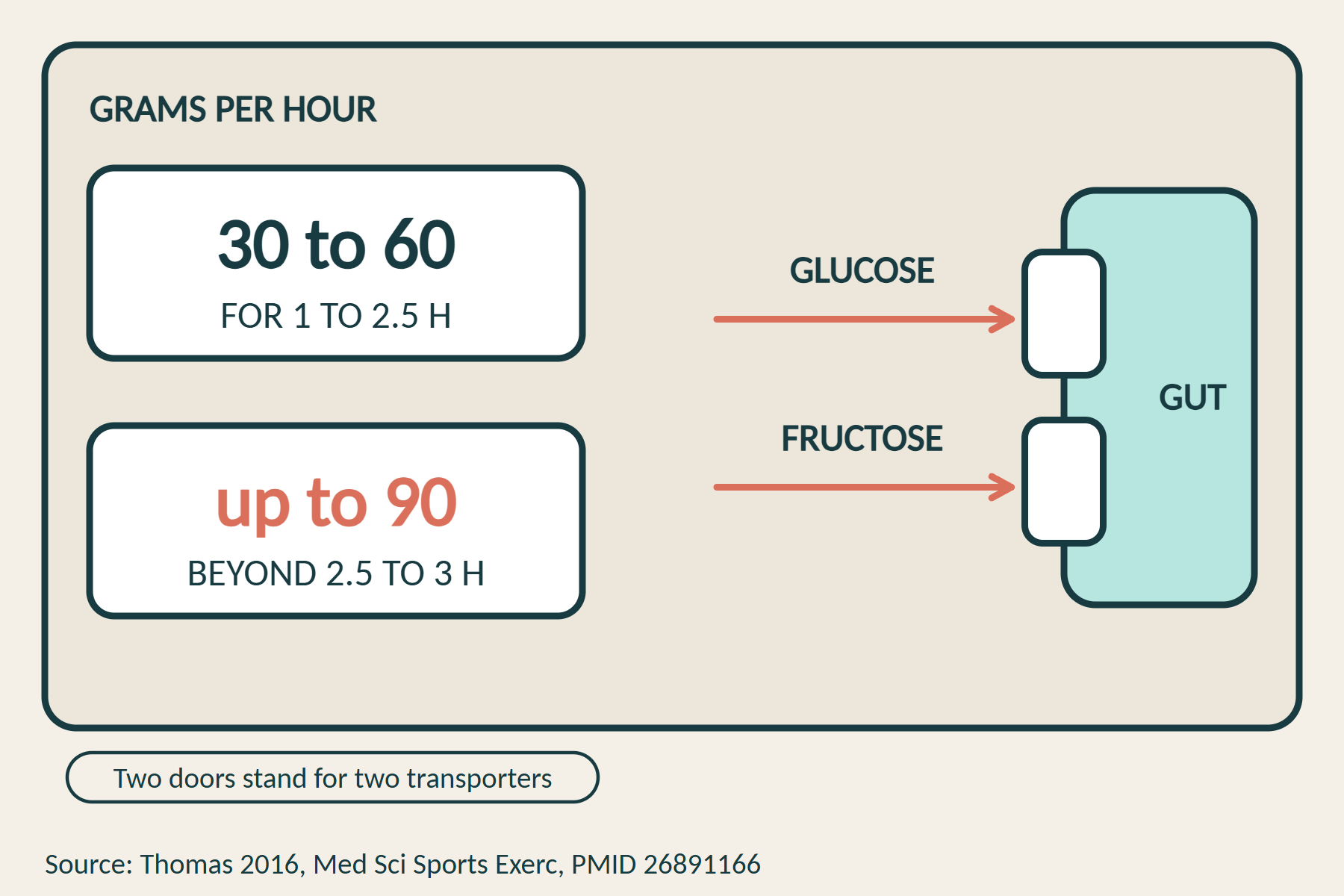
At 60 grams per hour that is roughly three gels of 20 to 25 grams each.
The gut limits what is usable: high-carbohydrate diets raise the density of the main intestinal glucose transporter, mostly in animal data, and stomach emptying and comfort can be trained.
Even so, in 37 highly trained athletes, two weeks of a high-carbohydrate diet plus gut training and 90 grams per hour during exercise had minor, highly variable effects, and the race walkers on that strategy reported more upper gut symptoms late in exercise.
Thomas Mortelmans
Related reading
Where athletes tend to land: Individual responses to the same intake differed markedly, so where athletes end up within the bands tends to follow their own symptoms as much as the number.
Method and a worked example
Studies of daily fueling tend to follow one pattern, which can be described step by step and which can fail.
Method
- Athletes of known training status are recruited, and each dose is scaled to body mass in grams per kilogram.
- A baseline block records habitual intake, training load and a reference test, such as a 10-kilometer time trial.
- Intake is then assigned by condition, for example 6 grams of carbohydrate per kilogram timed differently around sessions, with total energy held equal where possible.
- Outcomes are measured after one session or several weeks: performance, muscle biopsies, expired gas for fat and carbohydrate burning, and gut symptom scores.
- The hypothesis fails if matched groups perform alike, and with samples of 6 to a few dozen people the spread between individuals is reported next to the group average.
A composite case
This athlete is a composite, built to show the shape of the findings rather than real data.
A 70-kilogram cyclist trains four days a week: a 60-minute easy ride, 90 minutes of intervals, a four-hour long ride and a 90-minute easy ride.
In week one the cyclist eats about 6 grams of carbohydrate per kilogram every day, which is 420 grams, and 112 grams of protein in three meals.
The interval day feels flat, with perceived effort higher than the power numbers justify, and the long ride ends with hunger and slowing in the last hour.
Weeks two and three set carbohydrate near 4 grams per kilogram on free days, 5 on easy days, 7 on the interval day and 9 on the long-ride day, with protein flat at 1.6 grams per kilogram across four portions.
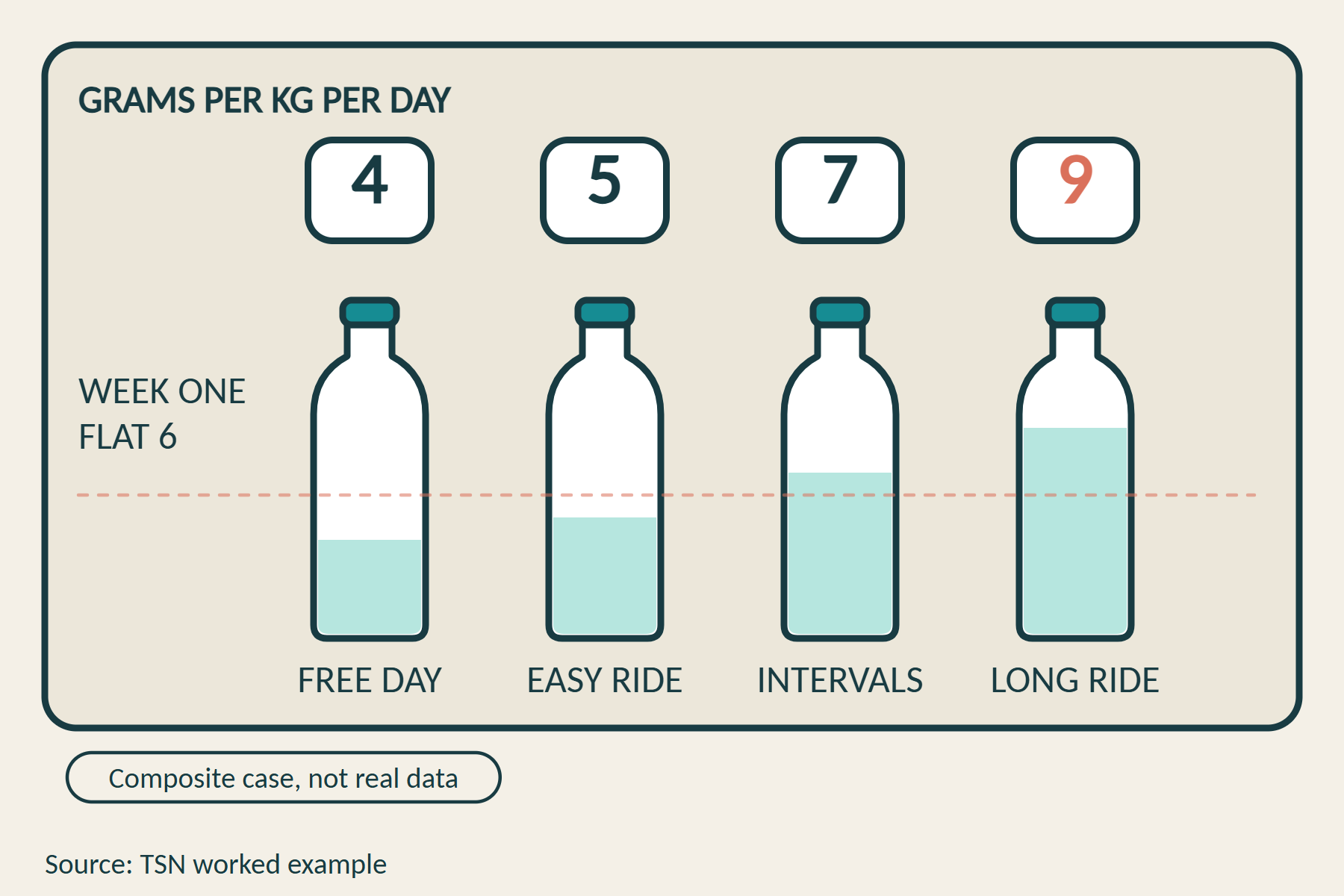
Intervals improve in week three, but a poor-sleep week four makes a 10-kilometer test 2 percent slower, which is close to ordinary test-to-test variation.
The payoff arrives late. During the long ride, intake of 60 grams per hour is raised in steps, an attempt at 90 grams per hour brings bloating in hour three, and the cyclist settles at 75.
Free calculator
Only by week six does the last hour of the long ride hold its power.
None of this shows that the plan caused the change, because training also built fitness over those six weeks.
Where this leaves us
Across a training week, the three macronutrients behave like one dial and two steadier settings.
Carbohydrate is the dial: the position stands let it swing by a factor of four as the day's work changes.
Protein stays in a band of 1.2 to 2.0 grams per kilogram and is spread across the day, and fat takes the energy that remains.
The evidence behind each piece differs in strength. The daily carbohydrate bands rest on expert consensus and on decades of glycogen physiology. The per-portion protein figures come mostly from resistance exercise.
Very low carbohydrate and very low fat intakes both showed costs, but in small studies with their own confounds. None of these numbers is a prescription. They mark where the evidence and the expert panels currently sit.
What I find most useful is that the week becomes the unit of analysis.
A single day's intake says little, while the pattern across a rest day, an interval day and a long day shows whether fuel is following the work.
Best regards, Dr. Thomas Mortelmans
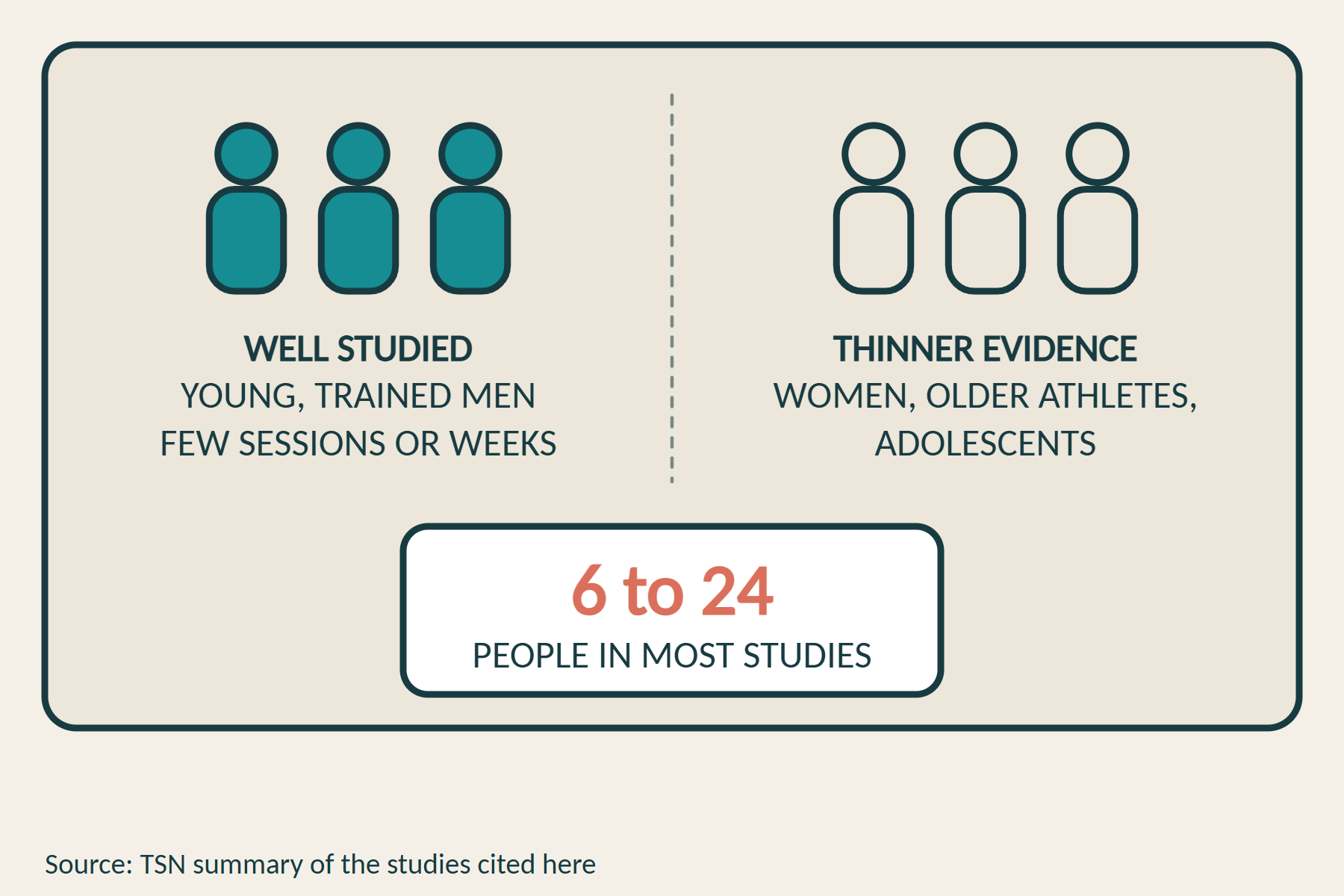
Limits of Application: The cited work mostly studies young, trained men, often in samples of 6 to 24 people, over single sessions or a few weeks.
Thomas Mortelmans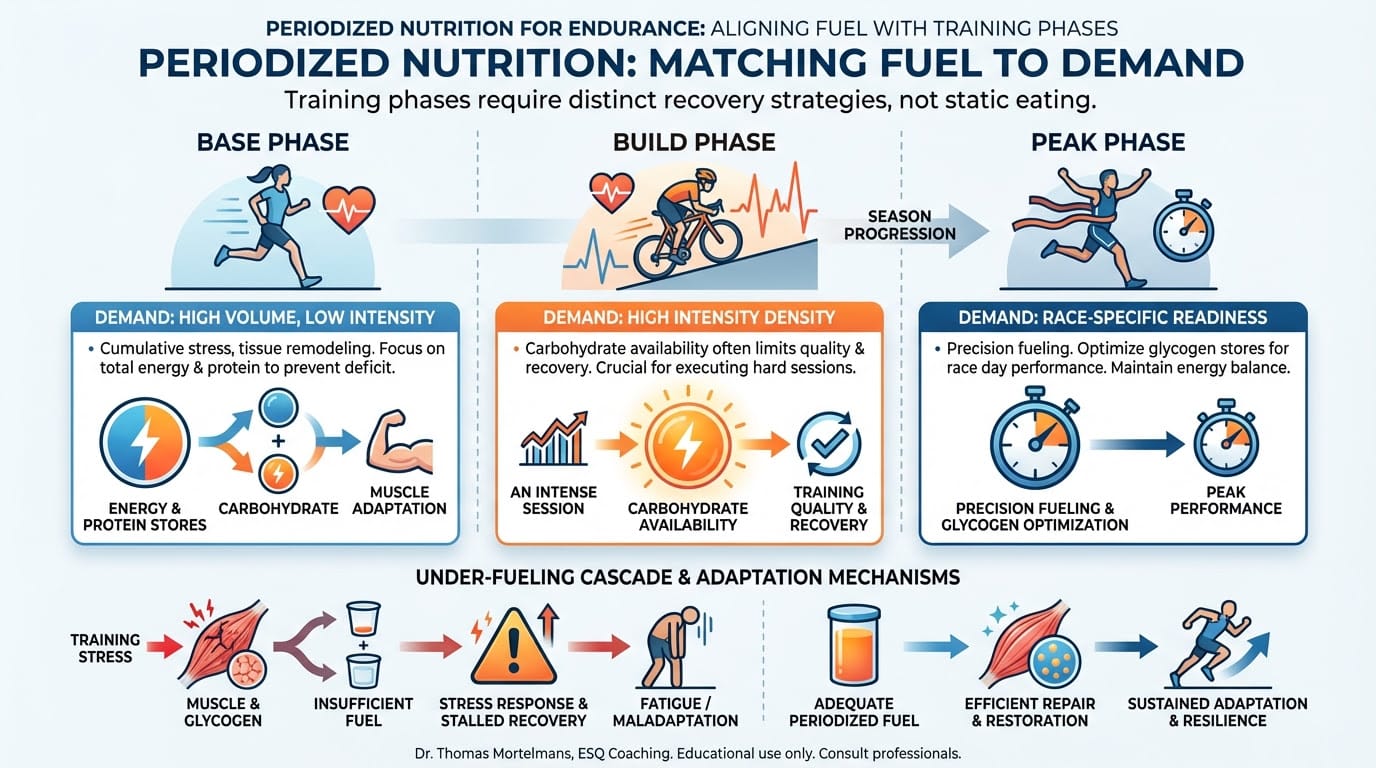
Related reading
Women, older athletes, adolescents, and people with medical conditions or food allergies are under-represented, and ranges per kilogram are population-level statements that any one individual may sit inside or outside.
Intake in these studies was controlled, while free-living eating is noisier. This post is not medical, dietetic or coaching advice.
References
- Thomas DT, et al. American College of Sports Medicine Joint Position Statement. Nutrition and Athletic Performance. Medicine and Science in Sports and Exercise. 2016. PMID 26891166. This joint position statement of three professional bodies sets out energy, carbohydrate, protein and fat recommendations for athletes, including daily carbohydrate bands of 3 to 12 grams per kilogram.
- International Olympic Committee. IOC consensus statement on sports nutrition 2010. Journal of Sports Sciences. 2011. PMID 22150426. This short consensus statement from the International Olympic Committee summarizes sports nutrition guidance for athletes, including carbohydrate intake matched to training load.
- Burke LM, et al. Carbohydrates for training and competition. Journal of Sports Sciences. 2011. PMID 21660838. This review sets out daily carbohydrate ranges by training load and intake during exercise of 30 to 60 grams per hour, up to 90 grams per hour in longer events.
- Jäger R, et al. International Society of Sports Nutrition Position Stand: protein and exercise. Journal of the International Society of Sports Nutrition. 2017. PMID 28642676. This position stand reviews protein needs of active people and describes daily totals of 1.4 to 2.0 grams per kilogram and portions of 20 to 40 grams every three to four hours.
- Kerksick CM, et al. International society of sports nutrition position stand: nutrient timing. Journal of the International Society of Sports Nutrition. 2017. PMID 28919842. This position stand reviews how the timing and spacing of carbohydrate and protein intake relate to training adaptation in athletes.
- Impey SG, et al. Fuel for the Work Required: A Theoretical Framework for Carbohydrate Periodization and the Glycogen Threshold Hypothesis. Sports Medicine. 2018. PMID 29453741. This review tallies studies of training with reduced carbohydrate, finding stronger adaptation signals in most but improved performance in about a third, and proposes matching carbohydrate availability to the session.
- Jeukendrup AE. Periodized Nutrition for Athletes. Sports Medicine. 2017a. PMID 28332115. This review defines periodized nutrition and notes that training-low studies show beneficial muscle signaling but few performance effects.
- Marquet LA, et al. Enhanced Endurance Performance by Periodization of Carbohydrate Intake: "Sleep Low" Strategy. Medicine and Science in Sports and Exercise. 2016. PMID 26741119. In 21 trained triathletes eating the same 6 grams of carbohydrate per kilogram daily, timing carbohydrate around sessions was followed by a 2.9 percent faster 10-kilometer run against 0.1 percent in controls over three weeks.
- Kato H, et al. Protein Requirements Are Elevated in Endurance Athletes after Exercise as Determined by the Indicator Amino Acid Oxidation Method. PLoS One. 2016. PMID 27322029. In six endurance-trained men after a 20-kilometer run, the recommended protein intake was estimated at about 1.8 grams per kilogram per day.
- Areta JL, et al. Timing and distribution of protein ingestion during prolonged recovery from resistance exercise alters myofibrillar protein synthesis. Journal of Physiology. 2013. PMID 23459753. In 24 trained men given 80 grams of whey protein over 12 hours after resistance exercise, four 20-gram portions every three hours produced more muscle protein synthesis than eight 10-gram or two 40-gram portions.
- Moore DR, et al. Ingested protein dose response of muscle and albumin protein synthesis after resistance exercise in young men. American Journal of Clinical Nutrition. 2009. PMID 19056590. In six young men after leg resistance exercise, muscle protein synthesis was maximally stimulated by 20 grams of egg protein, with more protein oxidized rather than built into tissue.
- Burke LM, et al. Adaptation to a low carbohydrate high fat diet is rapid but impairs endurance exercise metabolism and performance despite enhanced glycogen availability. Journal of Physiology. 2021. PMID 32697366. In 13 world-class male race walkers, five to six days of a low carbohydrate, high fat diet in the seven assigned to it more than doubled fat burning but raised oxygen cost by 5 to 8 percent, and a day of carbohydrate restoration did not reverse the performance impairment.
- Horvath PJ, et al. The effects of varying dietary fat on performance and metabolism in trained male and female runners. Journal of the American College of Nutrition. 2000. PMID 10682876. In 25 trained runners, endurance time was 14 percent longer after four weeks at 31 percent of energy from fat than after four weeks at 16 percent, while on the low-fat diet the runners also ate 19 percent fewer calories.
- Jeukendrup AE. Training the Gut for Athletes. Sports Medicine. 2017b. PMID 28332114. This review concludes that gastric emptying, comfort and intestinal absorption of carbohydrate can adapt to training and diet, including higher glucose transporter density after high-carbohydrate diets.
- King AJ, et al. Short-Term Very High Carbohydrate Diet and Gut-Training Have Minor Effects on Gastrointestinal Status and Performance in Highly Trained Endurance Athletes. Nutrients. 2022. PMID 35565896. In 19 elite race walkers and 18 highly trained runners, two weeks of a high-carbohydrate diet with gut training and 90 grams per hour had minor, highly variable effects on gut function and symptoms.
If you have 60 seconds, I would value your anonymous feedback. You can share it here.
Health disclaimer
This entry summarizes what studies and position stands report about carbohydrate, protein and fat across a training week. It describes research, not a plan for you. The studies mostly involved young, trained men in small samples, the figures are what those studies or panels reported, and the composite case is invented. Needs differ between people, and the ranges are population-level figures, not a prescription. Not medical advice.
Keep going
These are the numbers Gradescale computes from your own rides and runs, with the working shown.
Training plans built on the same evidence base:
Thomas MortelmansJoin our Discord community:
Thomas Mortelmans