Entry #046: Winter Training for Cyclists: Holding and Building Fitness Through the Cold, Dark Months
Winter takes less fitness than most cyclists expect. The cold and the dark mostly change what a ride costs, not what it builds.
That difference decides how much of a summer's work is still there in March.
The tension is real, though. From November to February, daylight shrinks, roads turn slick and the average week of riding gets shorter.
In a review of 37 studies and roughly 290,000 people, physical activity varied with season and poor weather acted as a barrier. The physiology adds a second pull.
Cold leaves the aerobic engine largely alone but shortens how long a given effort can be held, and very cold air strains the airways when the effort is hard.
So the habit can erode long before the capacity does.
This entry argues one thing.
The part of aerobic fitness that a shorter winter week puts at risk is the part that depends on hard riding, and that small amount of hard riding is cheap to protect.
The hours, the long steady rides and the outdoor miles can shrink by a third or more with less loss than the calendar suggests, as long as the hard work stays in the week.
Here is what I'll cover. I start with how little training holds aerobic fitness when volume drops.
Next comes what cold does to endurance and to the airways, and what changes when the ride moves indoors.
After that I look at how far running and skiing can stand in for riding, and what heavy strength work and sleep add through the dark months.
Along the way I say where the evidence runs out, because over a full five-month winter it runs out sooner than most training advice admits.
Four neighbors of this topic belong to their own posts, so each gets a single mention here: how fast fitness fades with time off, how intensity is spread across a week, how seasons are organized into blocks, and how heat acclimation works.
The way muscle temperature drives power has its own snippet, so it appears here only in passing. Indoor heat and sweat loss are a separate topic and get one descriptive sentence later.
The numbers in this piece are the kind Gradescale computes from your own rides and runs, with the working shown.
Introducing Gradescale
The brief
- Aerobic fitness appears to be held by intensity more than by hours. In general populations, endurance performance held for up to 15 weeks on two sessions a week, or 33% to 66% less volume, when intensity was kept up.
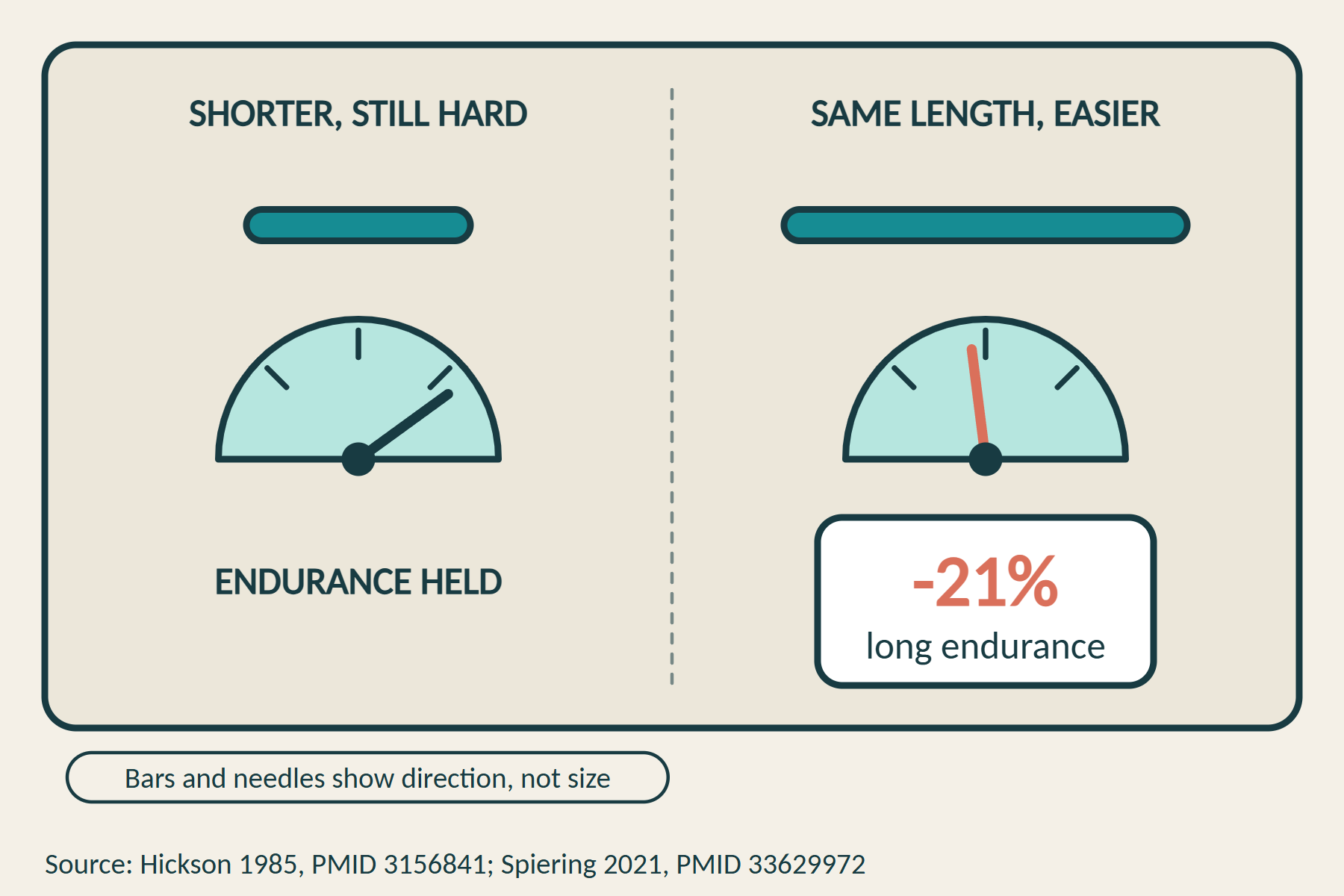
- Cutting the effort costs more than cutting the time. A one-third cut in intensity, with frequency and duration unchanged, dropped long endurance 21%, and a two-thirds cut dropped it 30%.
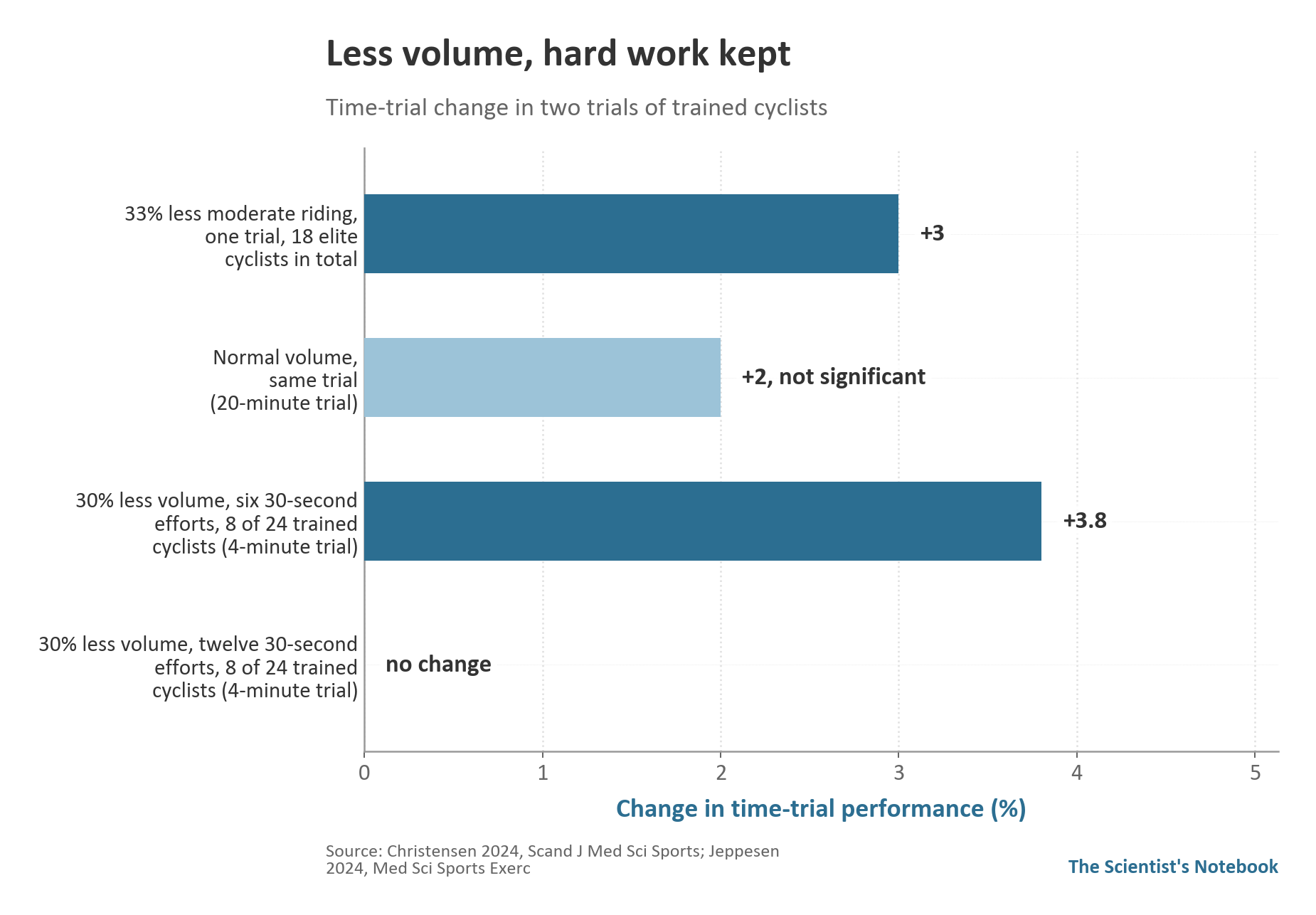
- Elite cyclists trimmed about a third of their moderate riding and still improved. Seven in-season weeks of intervals with 33% less moderate volume came with a 3% gain in a 20-minute time trial in 18 elite cyclists, against a non-significant 2% with normal volume.
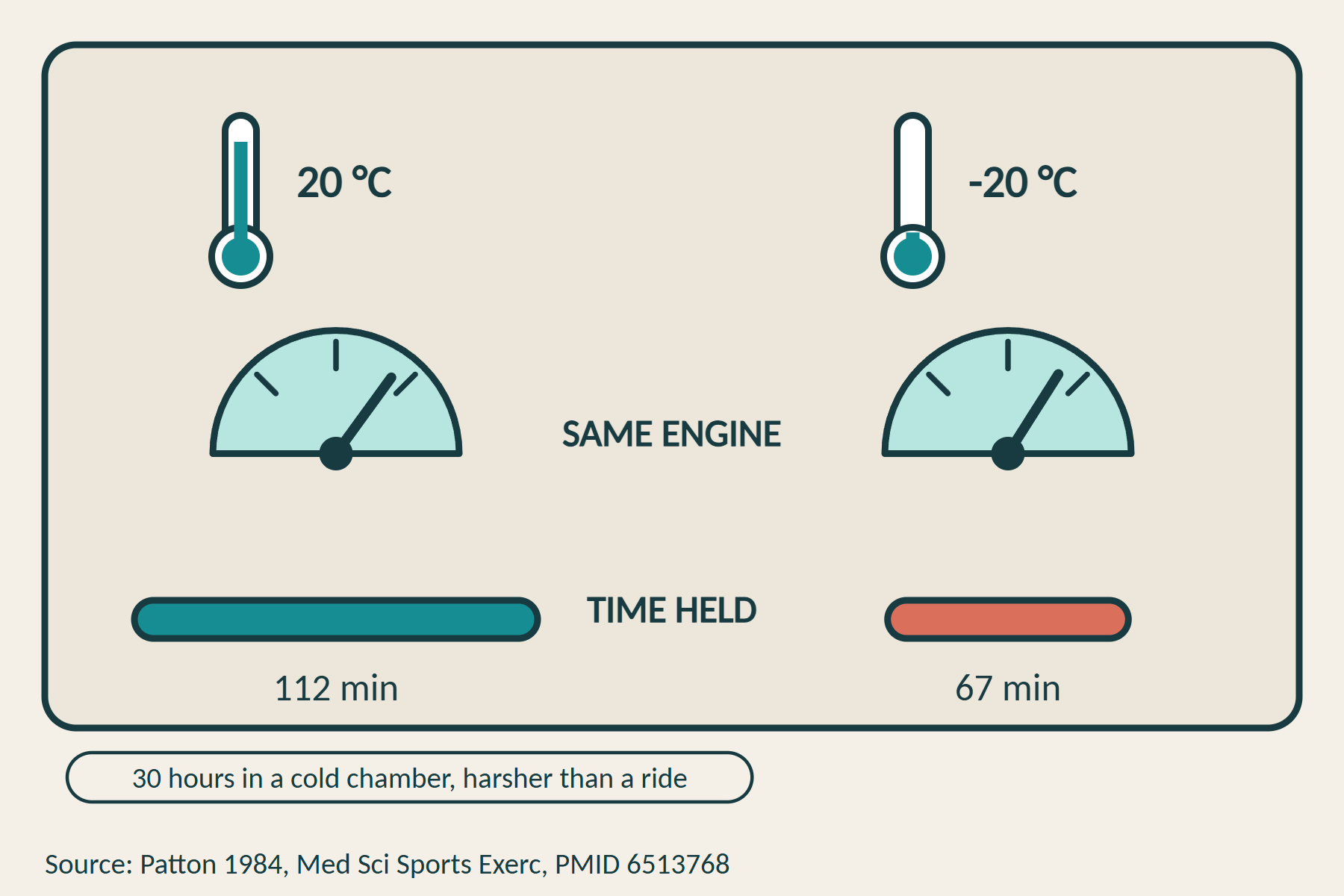
- Cold shortens how long an effort can be held without shrinking the engine. At -20 °C maximal oxygen uptake was 3.35 liters per minute against 3.43 at 20 °C, yet time to exhaustion fell 38% in eight young men.
- Cold air affects the airways in a temperature-dependent way. Forced exhaled volume in one second fell 6% to 8% after intense running at -20 °C, and no such fall appeared at 0 °C.
- An indoor trainer removes the cold and keeps the numbers repeatable. Twenty-minute time trials on a virtual platform repeated with a typical variation of 3.7%.
- Running carries some aerobic fitness over to cycling, though no more than riding itself. Transfer is clearest from running and weakest from swimming.
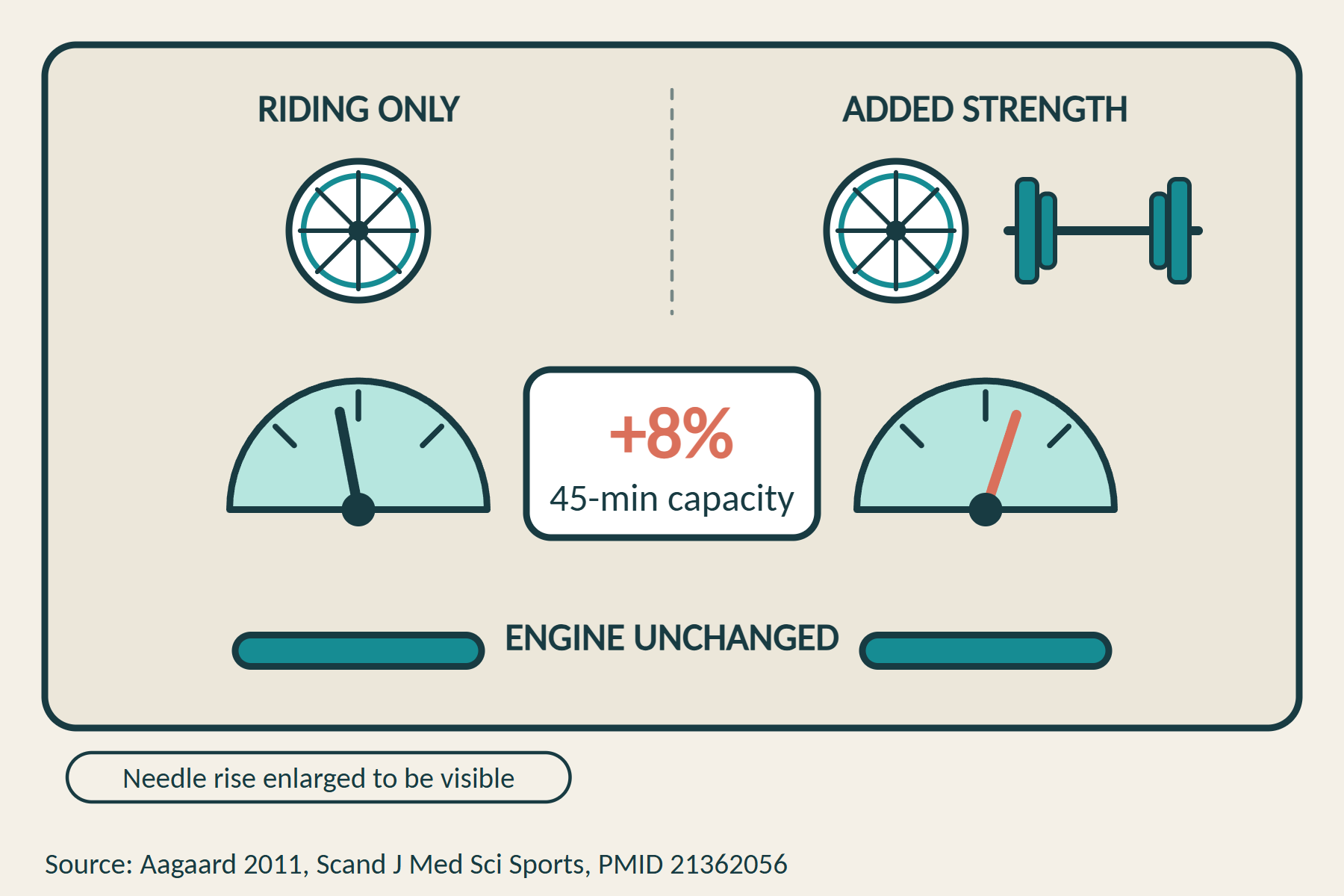
- Heavy strength work added to riding raised 45-minute time-trial capacity by 8%. That gain came in the strength-trained riders among 14 young elite cyclists over 16 weeks, with maximal oxygen uptake unchanged.
The science at a glance
Foundational Principle 1: Intensity is the signal that fitness keeps responding to
Aerobic fitness rests partly on the heart, which ejects more blood per beat after training, and partly on the oxidative capacity of working muscle.
During reduced training, both seem to depend more on how hard the effort is than on how long it lasts.
When people trained six days a week for 10 weeks and then cut intensity by a third for 15 weeks, with the same frequency and duration, maximal oxygen uptake slipped from its trained peak and the calculated mass of the heart's main pumping chamber returned to pretraining levels.
Cutting frequency or session length while the effort stays hard has a gentler record: endurance performance has been held for up to 15 weeks on two weekly sessions in general populations, and a 30% volume cut left highly trained cyclists' maximal oxygen uptake and muscle oxidative capacity unchanged over six weeks.
Scientist's Insight: Most maintenance data come from general populations and trials of six to 15 weeks, so how long a trained cyclist can hold fitness on a small dose across a five-month winter is an open question.
Foundational Principle 2: Cold changes what an effort costs, not what the engine can do
In one chamber exposure, maximal oxygen uptake barely moved between 20 °C and -20 °C, yet the time an intermittent effort at about 78% of that maximum could be held fell from 112 to 67 minutes.
 Thomas Mortelmans
That gap may fit what is known about muscle temperature: in short efforts, power moves by 2% to 5% for each degree Celsius of muscle temperature, and cold alters the neural drive that recruits muscle fibers.
Cold air also reaches the airways at a cost that depends on temperature.
After intense running at -20 °C, forced exhaled volume in the first second fell by 6% to 8% in both men and women, while 0 °C produced no such fall.
Among competitive cross-country skiers, 61% reported cough after exercise against 23% of the general population, yet cough beyond eight weeks was rarer in skiers (2.0% against 4.8%).
Scientist's Insight: The 38% loss comes from 30 hours in a -20 °C chamber, a far longer and colder exposure than a winter ride, so it shows the direction of the effect better than its size on a road.
Foundational Principle 3: Transfer is real, and specificity caps it
Fitness gained in one movement carries over to another, with a ceiling.
Gains in maximal oxygen uptake partly transfer between cycling, running and swimming, most clearly when running is the substitute and least when swimming is, and the transferred gain has not exceeded what the sport-specific mode produces.
The ceiling matters more for highly trained athletes. Heavy strength work sits outside that limit because it trains a different quality and adds to riding rather than replacing it.
In 14 young elite cyclists, 16 weeks of strength training alongside riding left maximal oxygen uptake unchanged, raised leg strength by 12% to 20% and lifted 45-minute time-trial capacity by 8%, a gain riding alone did not produce.
Scientist's Insight: The strength data in cyclists come from small groups of young, highly trained riders, so the direction is consistent while the size of the gain in an older recreational rider is not established.
Reading the signals
Lever 1: How much winter riding holds aerobic fitness
The data: In general populations, endurance performance has been maintained for up to 15 weeks on two sessions per week, or on 33% to 66% less volume with sessions as short as 13 to 26 minutes, provided intensity was kept up.
In 18 elite cyclists mid-season, a 33% cut in moderate riding alongside three weekly interval sessions came with a 3% gain in a 20-minute time trial, against 2% when volume stayed unchanged.
Among 24 highly trained cyclists, the group with a 30% volume cut and twice-weekly sessions of six 30-second efforts kept maximal oxygen uptake and prolonged endurance unchanged and raised 4-minute time-trial performance by 3.8%.
When intensity fell by a third instead, long endurance dropped from 184 to 145 minutes.
Where athletes tend to land: Athletes who keep two or three hard sessions while easy volume is trimmed first sit close to the arrangement the maintenance data describe.
Those who keep the hours and drop the hard sessions sit closer to the reduced-intensity arm, where long endurance fell by 21% to 30%.
Lever 2: Where the ride happens, in the cold or indoors
The data: Cold shortens how long a submaximal effort can be held, by 38% in eight young men at -20 °C, and warm-up matters.
In 10 junior alpine skiers at -7 °C, an active warm-up tended to leave jump height and 90-second cycling power higher than a heated garment alone, and the skiers felt warmer.
Indoors, the cold disappears and power is repeatable: 44 cyclists repeating 20-minute time trials on a virtual platform at home varied by a typical 3.7% (about 9 W) between trials.
Poor weather acts as a barrier to regular activity in a review of 37 studies. Indoor rides bring heat and sweat loss of their own, a topic for a separate post.
Where athletes tend to land: Indoor riders trade the road's handling, wind and terrain for repeatable numbers and no cold. Outdoor riders keep that specificity and pay in warm-up time.
Lever 3: What surrounds the riding, in cross-training, strength and sleep
The data: Running passes more aerobic fitness to cycling than swimming does, and neither passes more than cycling itself. No controlled comparison of cross-country skiing and riding is cited here.
Heavy strength training added to endurance work has the most compelling record for cycling among strength methods, and in young elite cyclists it lifted the strength group's 45-minute capacity by 8% over 16 weeks.
Strength itself has been held for up to 32 weeks on one weekly session with one set per exercise at the same relative load in younger general populations.
Elite athletes often sleep under seven hours a night, and in the wider population habitual sleep under seven hours is associated with greater susceptibility to respiratory infection.
Where athletes tend to land: Athletes who add a strength block on top of their riding sit closest to the cyclist trials, where strength was added to endurance training and did not replace it.
Thomas Mortelmans
Related reading
Sleep is the least settled lever: the performance effect of one to three nights of partial restriction remains unclear, the athlete studies carry weak experimental control and few women, and the consensus statement favors an individualized approach over a fixed 7 to 9 hours.
Method and a worked example
A winter-maintenance question can be tested with a simple design, and the case below shows how real life interferes.
Method
- A group of trained cyclists completes a baseline block recording maximal oxygen uptake, a 20-minute time trial and a prolonged ride ending in a short all-out effort.
- Participants are split at random into a reduced-volume group and a normal-volume group that keep the same hard sessions, which holds intensity constant and leaves volume as the main difference.
- A third arm keeps its volume but drops the hard sessions, which isolates intensity as the variable. The hypothesis fails if this arm holds its fitness as well as the arms with hard sessions.
- Measurements are repeated at six to seven weeks, the length of the cyclist trials, and again later where possible, because maintenance over 15 weeks has been measured mainly in general populations.
- Results are read against measurement noise: a repeated 20-minute home trainer time trial varies by a typical 3.7%, so a change of 2% to 3% in one athlete cannot be separated from noise without repeated trials.
A composite case
The athlete in this composite is a recreational road cyclist who rode about 10 hours a week through the summer and, from November, has about four: two hard sessions on a trainer, one steady ride and one easy spin.
The first trainer time trial in week two reads 5% below the September outdoor value, and the athlete reads it as lost fitness.
Two weeks later the same trial reads 2% below. The three-point gap sits inside the 3.7% typical variation between repeats, so it fits noise as much as change.
Thomas Mortelmans
Related reading
Then week five goes wrong: a head cold, three poor nights of sleep and two skipped hard sessions. The week-six trial reads 4% below September, and nothing about that week looks like progress.
The payoff arrives late. By week 12, after six consistent weeks, the trial sits within the noise band of the September value.
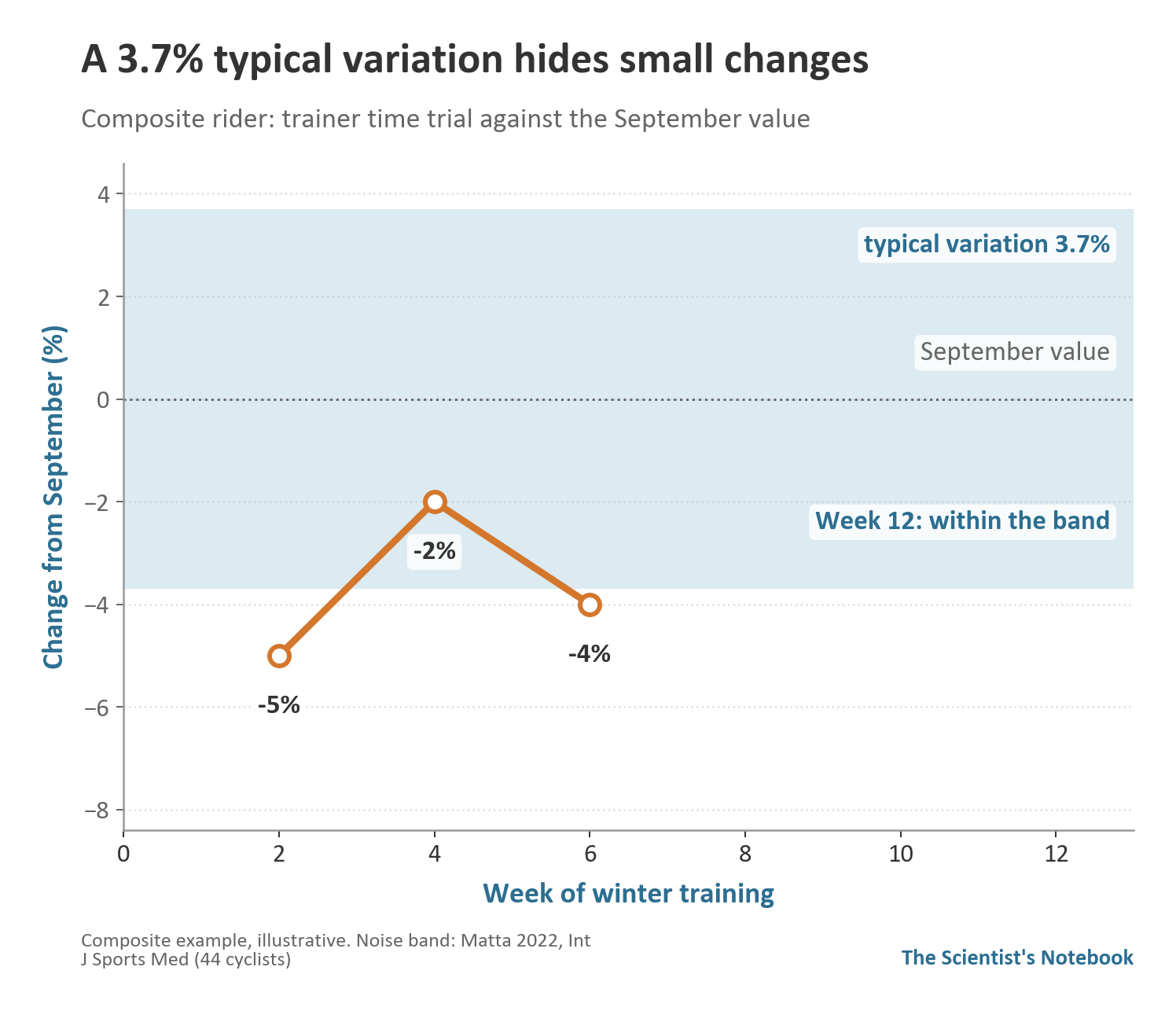
One composite settles nothing about another rider, but it shows the shape the data allow: an early dip, a setback that looks bigger than it is, noise that hides small changes and a gain that shows up after the weeks, not within them.
Where this leaves us
Across all of this, one pattern repeats. Winter takes away the easy parts of training, the daylight, the dry road and the long ride, and leaves the hard parts intact.
The hard parts are the ones the maintenance data say fitness mostly depends on.
That is a more forgiving finding than the usual winter story, and it comes with a condition: the forgiveness has been measured over six to 15 weeks, not over a whole season.
The cold itself behaves like a tax on the session more than a threat to the engine.
Maximal oxygen uptake stays put while the time an effort can be held shrinks, and a trainer trades the road's specificity for repeatable numbers.
I find it useful to keep what a ride costs apart from what it builds, because winter makes them look like one.
What the literature does not yet say matters as well.
No study cited here follows a cyclist from November to the first race, few include women, and nothing separates a good winter from a lucky one in a single athlete.
I would rather leave that open than fill it with confidence the data cannot support.
Best regards, Dr. Thomas Mortelmans
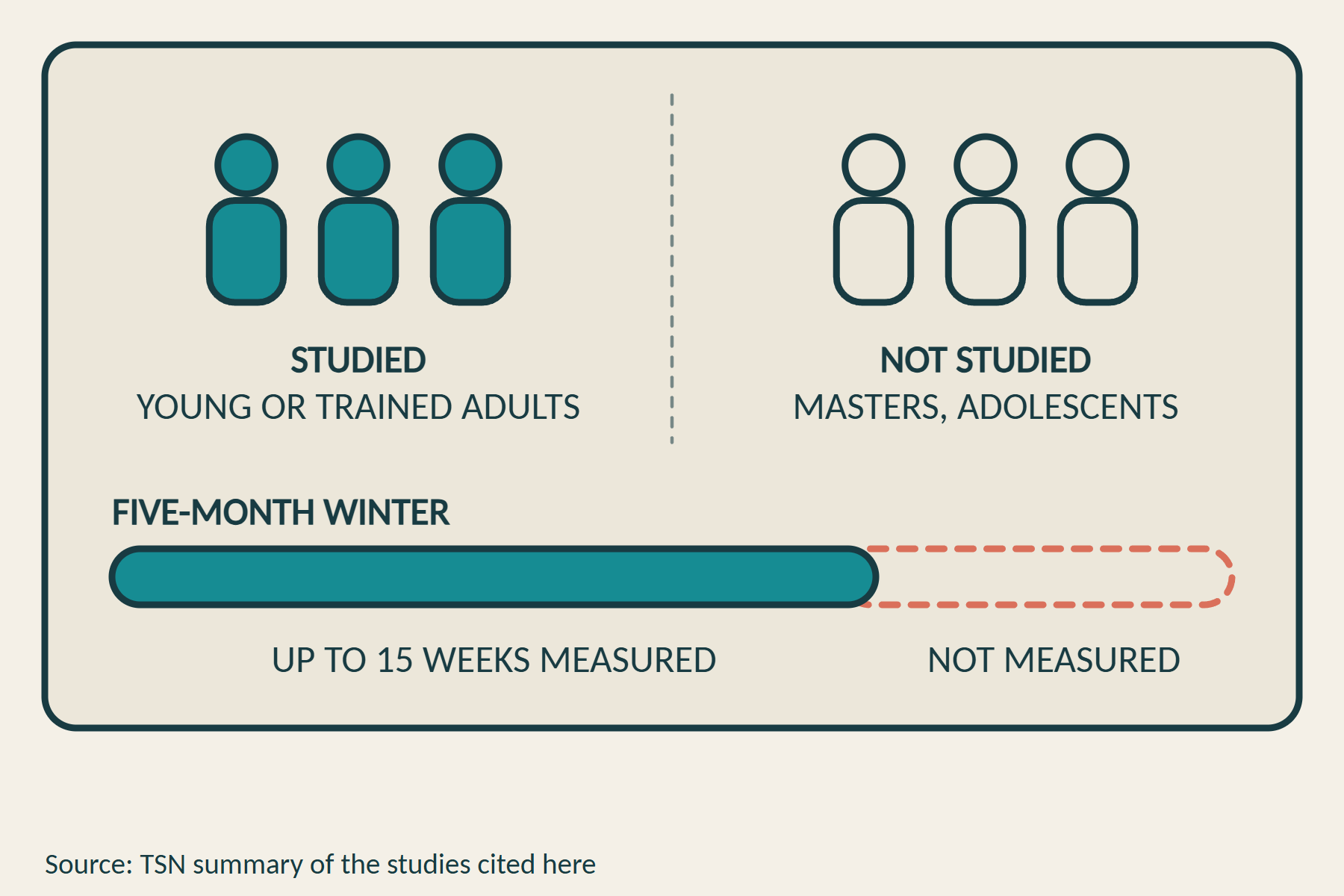
Limits of Application: The studies cited here are mostly short (six to 16 weeks), small (eight to 44 participants in the cyclist and exposure trials) and drawn from young or trained adults, often men, so they do not describe masters athletes or adolescents.
Maintenance data come mainly from general populations, the cold-exposure figures from chamber settings that differ from a road, and the skiing evidence from questionnaires with low response rates.
Individual response varies, and this entry is educational and not medical or coaching advice.
References
- Hickson RC, et al. Reduced training intensities and loss of aerobic power, endurance, and cardiac growth. Journal of applied physiology (Bethesda, Md. : 1985). 1985. PMID 3156841. In 12 people trained for 10 weeks and then trained for 15 more weeks at one-third or two-thirds lower intensity, with frequency and duration unchanged, maximal oxygen uptake fell from its trained level, long endurance dropped 21% to 30% and calculated left ventricular mass returned to pretraining levels.
- Spiering BA, et al. Maintaining Physical Performance: The Minimal Dose of Exercise Needed to Preserve Endurance and Strength Over Time. Journal of strength and conditioning research. 2021. PMID 33629972. This narrative review found that endurance performance in general populations was maintained for up to 15 weeks on as little as two weekly sessions or 33% to 66% less volume if intensity stayed up, and strength for up to 32 weeks on one weekly session.
- Christensen PM, et al. Importance of training volume during intensified training in elite cyclists: Maintained vs. reduced volume at moderate intensity. Scandinavian journal of medicine & science in sports. 2024. PMID 37002854. In 18 elite male cyclists doing seven weeks of in-season interval training, a 33% cut in moderate-intensity volume was followed by a 3% gain in a 20-minute time trial, against a non-significant 2% with maintained volume.
- Jeppesen JS, et al. Low-Volume Speed Endurance Training with Reduced Volume Improves Short-Term Exercise Performance in Highly Trained Cyclists. Medicine and science in sports and exercise. 2024. PMID 38650113. In 24 highly trained male cyclists, the group doing six weeks of twice-weekly sessions of six 30-second efforts with 30% less overall training kept maximal oxygen uptake and muscle oxidative capacity and improved a 4-minute time trial by 3.8%, while a twelve-effort group did not.
- Patton JF, et al. Effects of acute cold exposure on submaximal endurance performance. Medicine and science in sports and exercise. 1984. PMID 6513768. In eight young men, 30 hours at -20 °C left maximal oxygen uptake unchanged but cut time to exhaustion at about 78% of that maximum by 38% compared with +20 °C.
- Racinais S, et al. Temperature and neuromuscular function. Scandinavian journal of medicine & science in sports. 2010. PMID 21029186. This review reports that short-duration performance improves by 2% to 5% per degree Celsius of muscle temperature and that both cold and heat impair performance through changes in neural drive.
- McGawley K, et al. Comparing Active, Passive, and Combined Warm-Ups Among Junior Alpine Skiers in -7°C. International journal of sports physiology and performance. 2021. PMID 33588374. In 10 junior alpine skiers at -7 °C, active and combined warm-ups were likely to give higher jump height and 90-second cycling power than a heated garment alone, and skiers felt warmer.
- Mäki-Heikkilä R, et al. Cross-country skiers often experience respiratory symptoms during and after exercise but have a low prevalence of prolonged cough. BMJ open sport & exercise medicine. 2023. PMID 37342789. A questionnaire survey of 1,282 Finnish skiers and 1,754 general-population respondents found post-exercise cough in 60.6% versus 22.8%, with cough beyond eight weeks in 2.0% versus 4.8%.
- Kennedy MD, et al. Are Respiratory Responses to Cold Air Exercise Different in Females Compared to Males? Implications for Exercise in Cold Air Environments. International journal of environmental research and public health. 2020. PMID 32933124. In 18 athletes (nine female) running at 0 °C and -20 °C, forced exhaled volume in one second fell about 6% to 8% in both sexes at -20 °C but not at 0 °C.
- Tanaka H, et al. Effects of cross-training. Transfer of training effects on VO2max between cycling, running and swimming. Sports medicine (Auckland, N.Z.). 1994. PMID 7871294. This review concluded that maximal oxygen uptake gains transfer partly between modes, most from running and least from swimming, and do not exceed those from the sport-specific mode.
- Rønnestad BR, et al. Optimizing strength training for running and cycling endurance performance: A review. Scandinavian journal of medicine & science in sports. 2014. PMID 23914932. This review of endurance-trained runners and cyclists found the most compelling evidence for an additive effect of heavy strength training on cycling performance.
- Aagaard P, et al. Effects of resistance training on endurance capacity and muscle fiber composition in young top-level cyclists. Scandinavian journal of medicine & science in sports. 2011. PMID 21362056. In 14 young elite cyclists, the group that added 16 weeks of strength training raised leg strength 12% to 20% and 45-minute time-trial capacity 8% without changing maximal oxygen uptake, a 45-minute gain the endurance-only group did not show.
- Walsh N, et al. Sleep and the athlete: narrative review and 2021 expert consensus recommendations. British journal of sports medicine. 2020. PMID 33144349. This expert consensus reports that elite athletes often sleep under seven hours, that the effect of partial sleep restriction on performance is unclear, and that sleep advice should be individualized.
- Tucker P, et al. The effect of season and weather on physical activity: a systematic review. Public health. 2007. PMID 17920646. This systematic review of 37 studies and 291,883 participants found that physical activity varies with season and that poor weather acts as a barrier to participation.
- Matta G, et al. Reproducibility of 20-min Time-trial Performance on a Virtual Cycling Platform. International journal of sports medicine. 2022. PMID 35537457. In 44 cyclists doing three 20-minute time trials at home on a virtual platform, mean power repeated with an intraclass correlation of 0.97 and a coefficient of variation of 3.7%.
If you have 60 seconds, I would value your anonymous feedback. You can share it here.
Health disclaimer
This entry summarizes what studies found about winter training volume, intensity, cold exposure, cross-training, strength work and sleep. It describes research, not a plan for you, and most of the studies were short and small. Individual responses to cold and to hard efforts vary. A schedule that worked for a study group is not a recommendation, and winter weather changes what is practical. Not medical advice.
Free calculator
Keep going
These are the numbers Gradescale computes from your own rides and runs, with the working shown.
Training plans built on the same evidence base:
Thomas MortelmansJoin our Discord community:
Thomas Mortelmans