
Entry #043: Easy, Hard, or In Between: How Endurance Athletes Split a Training Week Across Intensity Zones
A coach I trained under years ago kept a worn spiral notebook in which he logged every session his athletes did, sorted into three columns: easy, moderate, hard (even more old-school than excel ;) )
At the end of each month he added up the minutes in each column and stared at the proportions as if they held a secret. They did, in a way.
The shape of those three columns, the relative share of total training time spent going easy, going moderately hard, and going truly hard, turns out to be one of the most studied and most argued-over questions in endurance physiology.
The numbers in that notebook were a primitive version of what researchers now call training intensity distribution.
This entry is about that distribution: how a given week of training gets divided across intensity zones, and what happens to the body when the slices are drawn one way versus another.
It is a separate question from how training is sequenced across a season, the calendar of base blocks, build blocks, and tapers that a sibling entry covers under the heading of periodization. Here the lens is narrower and, in a sense, more immediate.
 Thomas Mortelmans
Related reading
Take a fixed pile of training hours in a single week. Should most of those hours sit comfortably below the first lactate threshold, with a small sharp wedge of very hard work on top?
Should a larger share live in the murky middle, at or near the second threshold where the effort feels sustainable but pointed? Or should the whole pile tilt toward repeated high-intensity intervals?
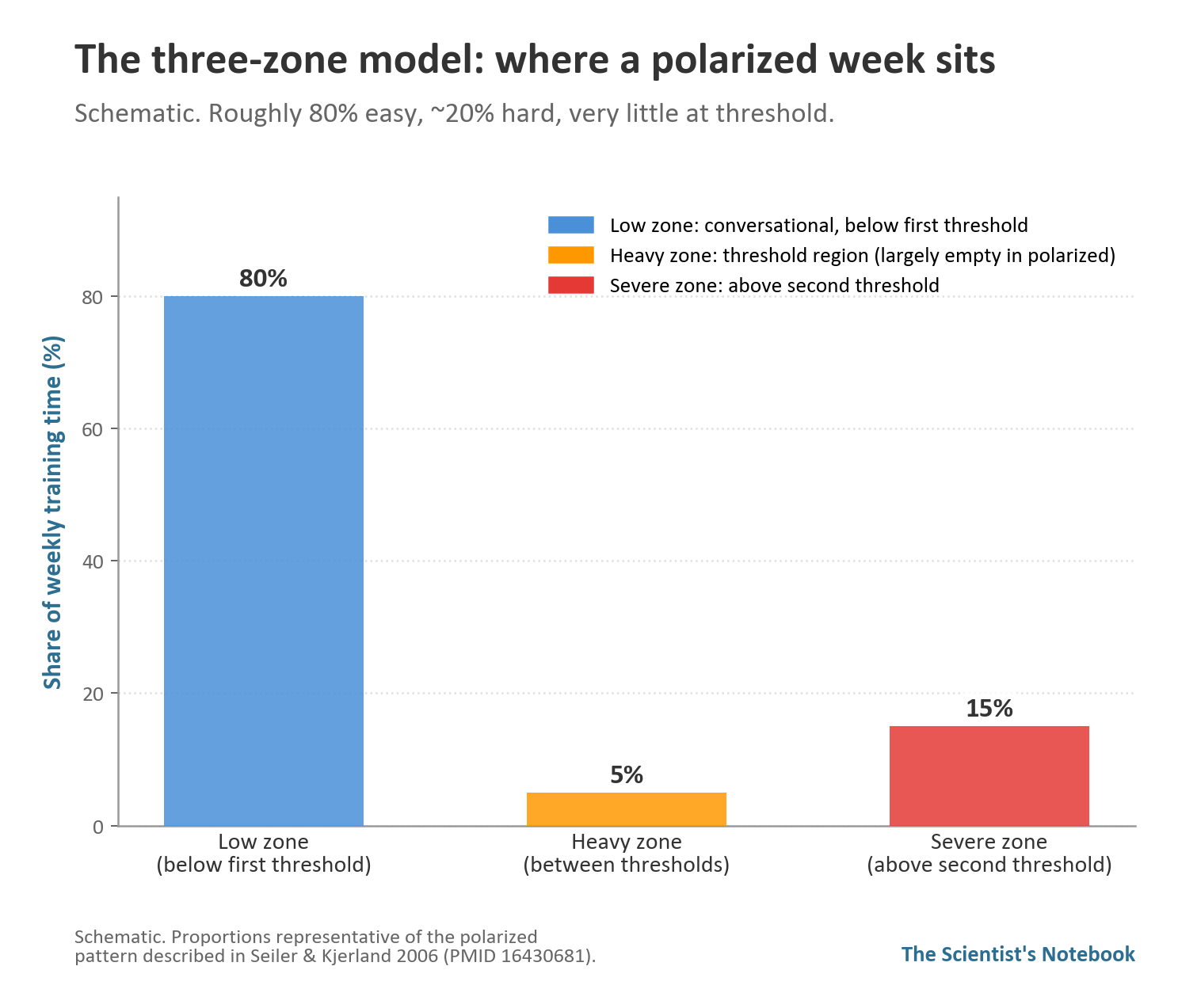
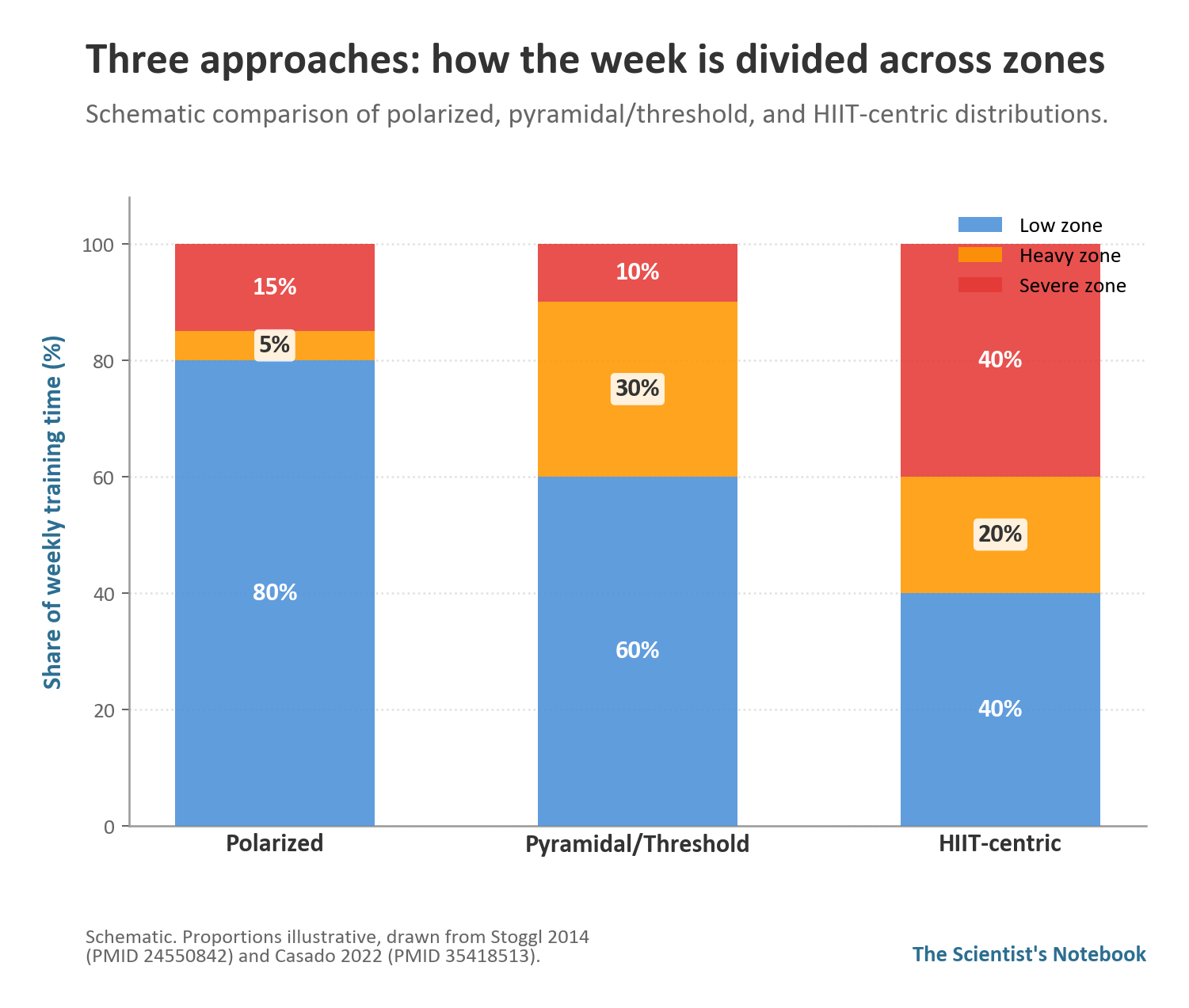
Three archetypes organize the conversation. The polarized model concentrates work at the two extremes, roughly four-fifths easy and one-fifth hard, with very little time spent at threshold.
The pyramidal or threshold-leaning model gives a larger share to that near-threshold middle zone, tapering from a broad easy base to progressively less time as intensity climbs.
Free calculator
And the high-intensity-centric approach leans on short, potent interval sessions to carry the aerobic stimulus when time is scarce.
What follows lays out what each shape does mechanistically, what the head-to-head studies actually found, and where the honest uncertainty lives, because the evidence here is genuinely phase-dependent, caliber-dependent, and muddied by the fact that different labs cannot agree on where one zone ends and the next begins.
Gradescale: Your physiology, decoded. Join the waitlist now.
 Thomas Mortelmans

The brief
- Distribution is about the week, not the season. It describes how one week's total training time is sliced across easy, moderate, and hard zones, a different axis from how blocks are sequenced across months.
- The three-zone map anchors everything. Most schemes split intensity into a low zone below the first threshold, a heavy zone around the second threshold, and a severe zone above it, then count time in each.
- Polarized means easy plus hard, with a hollow middle. The pattern observed in many elite athletes places roughly four-fifths of training time in the low zone and most of the rest in the severe zone, with little near threshold.
- Threshold and pyramidal models fill the middle. These distributions allocate a larger share to the heavy zone at or near the second threshold, tapering volume as intensity rises rather than skipping the middle.
- Head-to-head trials in trained athletes tend to favor more polarized shapes. Several controlled studies report larger gains in peak power, threshold velocity, and oxygen uptake when the hollow-middle pattern is compared against threshold-heavy work.
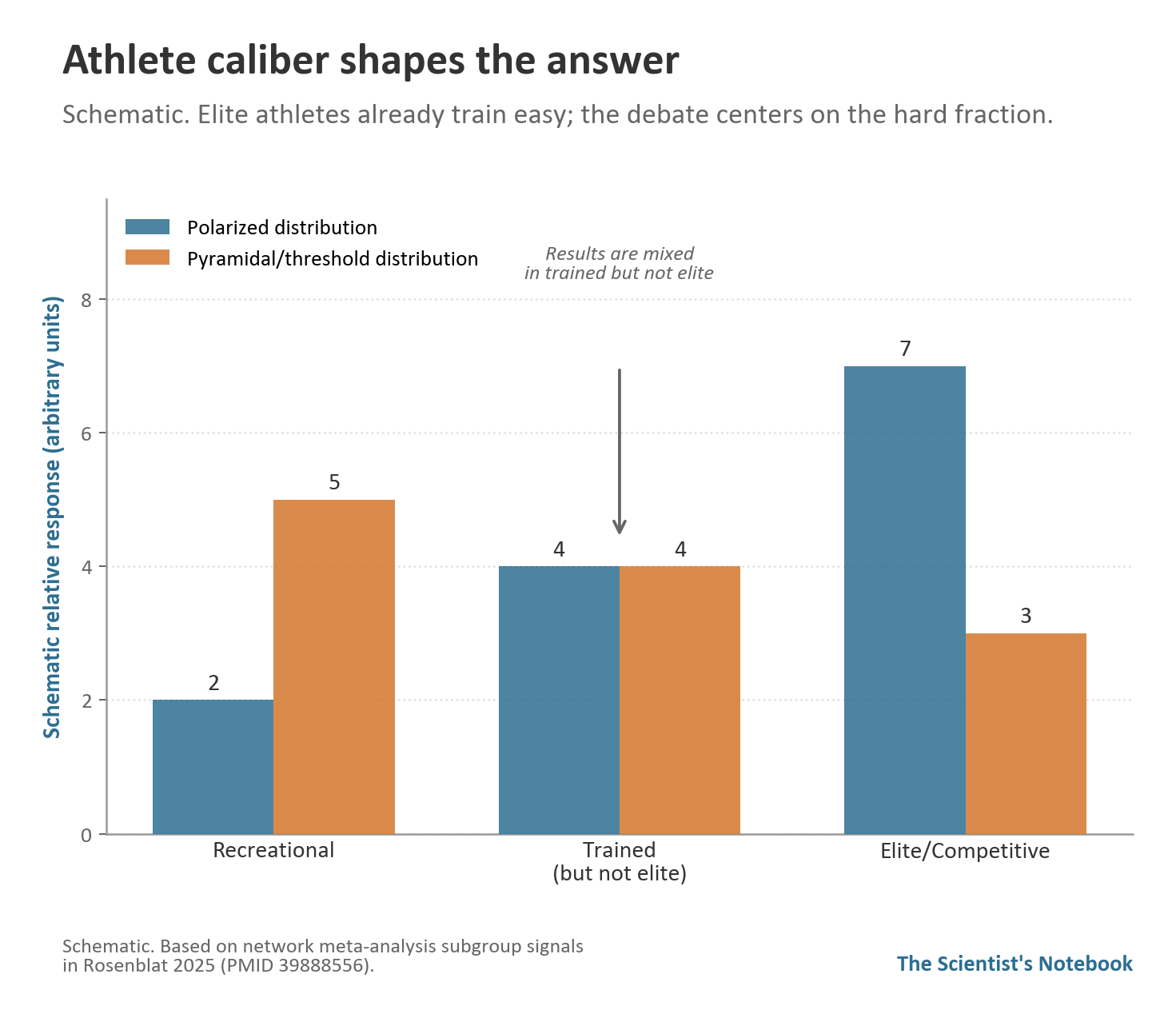
- Caliber and phase change the answer. Already-elite athletes accumulate enormous low-intensity volume regardless of label, while results in trained-but-not-elite athletes are genuinely mixed and may favor pyramidal shapes.
- High-intensity work is potent but costly per hour. Brief intervals drive oxygen uptake and mitochondrial signaling efficiently, yet they generate fatigue that limits how often they can be repeated.
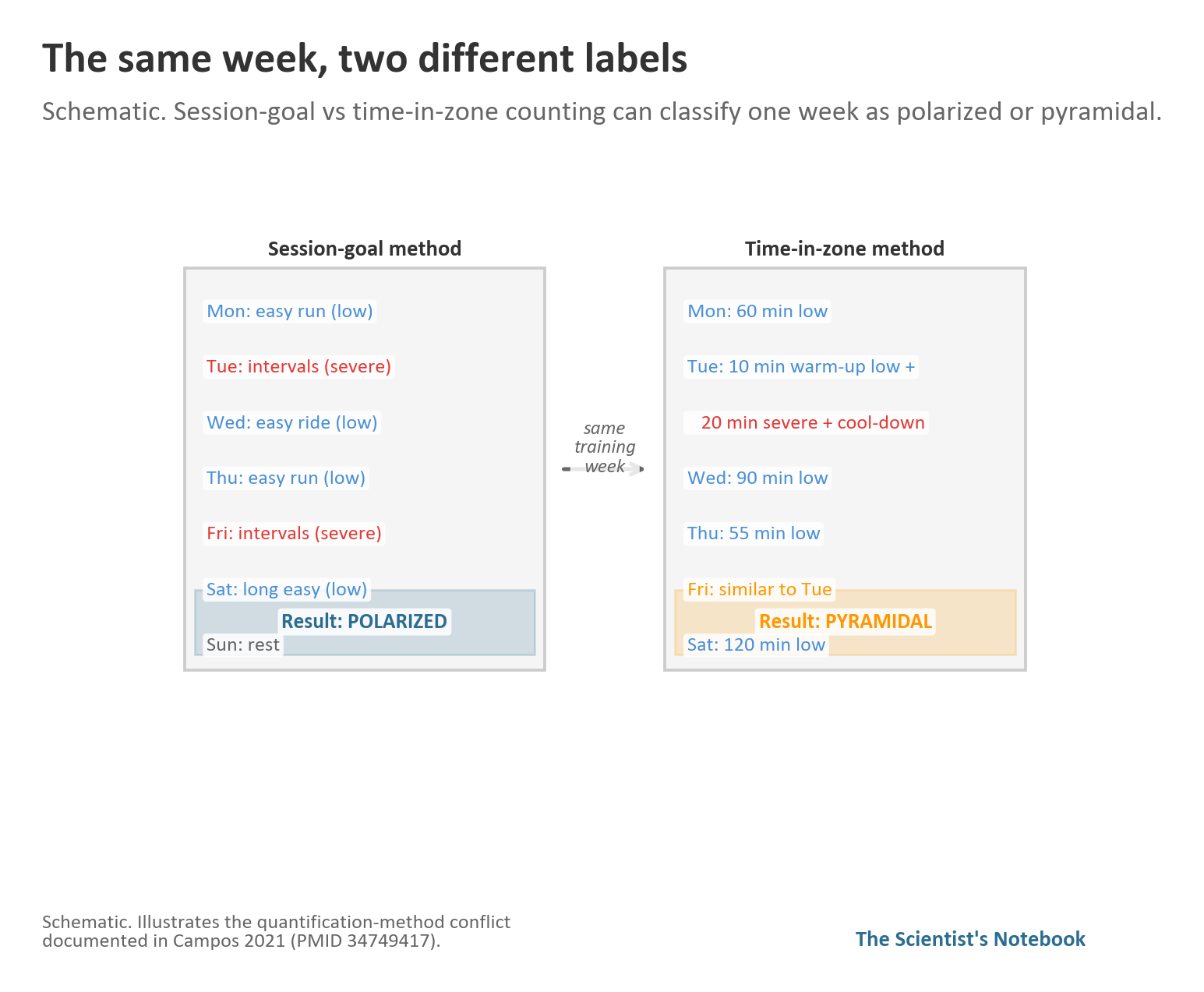
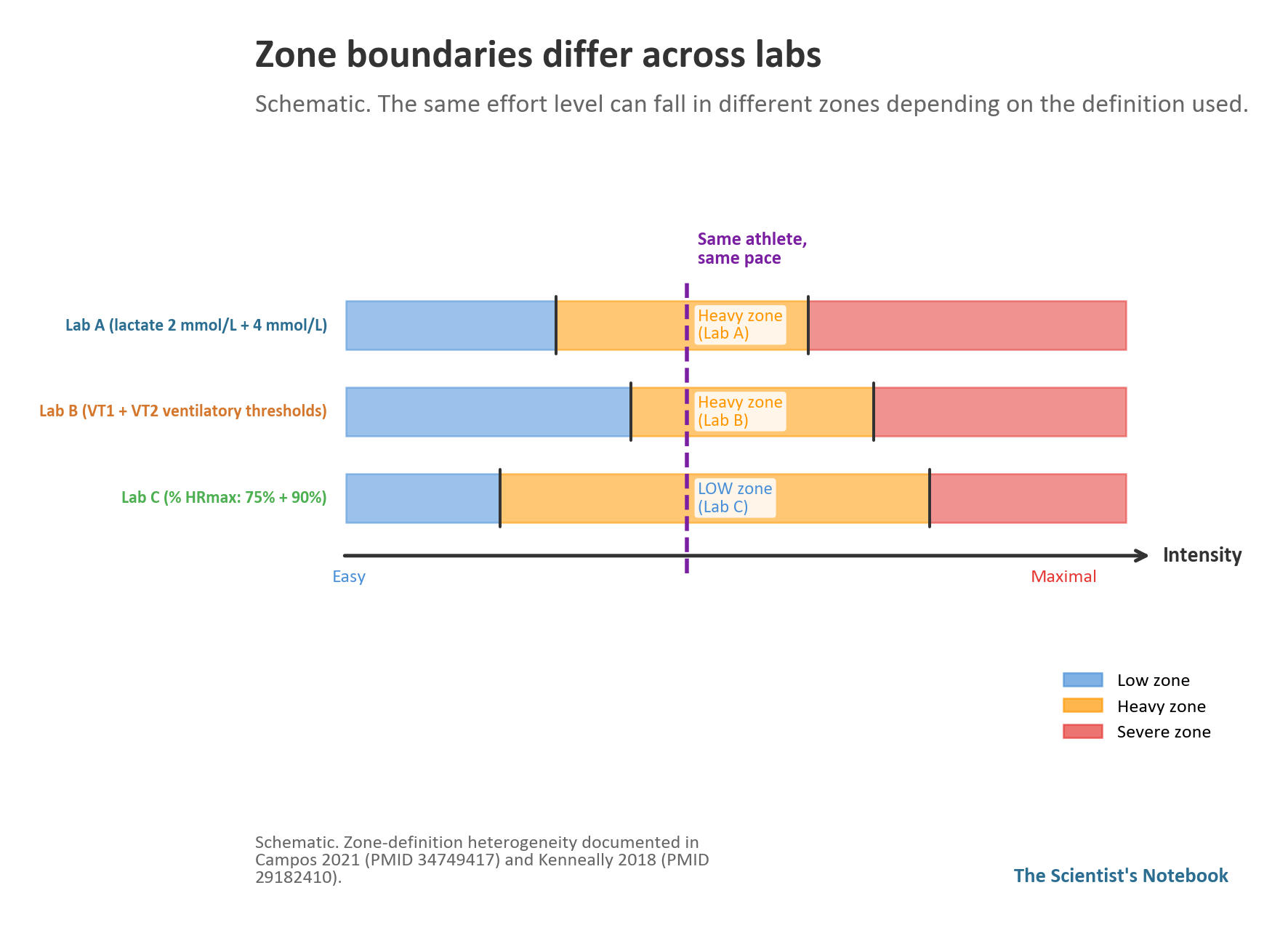
- Cross-study comparison is harder than it looks. Zone boundaries differ between labs, interventions are short, and counting by time-in-zone versus session goal can relabel the same week as polarized or pyramidal.
The science at a glance
Foundational Principle 1: The three-zone frame and the hollow middle
The intensity axis is usually carved into three domains by two landmarks: a first threshold, below which lactate stays near resting levels and effort feels conversational, and a second threshold, above which lactate climbs steadily and the clock starts ticking on how long the effort can last.
Low-zone work sits below the first landmark, heavy-zone work occupies the band between the two, and severe-zone work lives above the second. A distribution is simply the bookkeeping of how many minutes fall into each band over a week.
The polarized shape is striking precisely because it leaves the heavy middle nearly empty, pairing a large easy base with a smaller but genuinely hard cap, on the logic that the middle zone extracts a high fatigue cost for a modest adaptive return.
Scientist's Insight: A distribution is a histogram of effort, and the most debated histograms are the ones that deliberately leave a gap where intuition says the race-specific work should go.
Foundational Principle 2: Why easy volume and hard volume do different jobs
Low-intensity volume and high-intensity volume are not interchangeable currencies that happen to differ in exchange rate; they stimulate partly different machinery.
Sustained easy work, accumulated in large quantities because it barely disturbs daily recovery, supports peripheral adaptations: denser capillary networks, a greater capacity to oxidize fat and spare carbohydrate, and the cardiac filling that comes from many hours of moderate pumping.
Short severe-zone efforts, by contrast, lean on central and signaling pathways, pushing oxygen uptake toward its ceiling and triggering the molecular cascades that build mitochondrial content quickly.
The appeal of pairing the extremes is that each end does work the other cannot, while the easy base keeps total fatigue low enough to permit frequent hard sessions.
Scientist's Insight: Easy training and hard training are less a spectrum to be averaged than two distinct stimuli that a week's distribution chooses to combine in some ratio.
Foundational Principle 3: Fatigue is the hidden constraint on the histogram
Every distribution is ultimately bounded by how much disruption a body can absorb and still adapt. The heavy middle zone is metabolically expensive: it accumulates lactate, raises sympathetic drive, and leaves residual fatigue that limits how many quality sessions a week can hold.
When too much of the week clusters at one demanding intensity, the monotony of daily stress can outrun recovery and blunt the very adaptations the training was meant to produce.
Thomas Mortelmans
The hollow-middle logic is partly a fatigue-management argument: by keeping most volume genuinely easy, the body banks enough recovery to make the sparse hard sessions count, rather than spending its adaptive budget on moderately hard work every day.
Scientist's Insight: The ceiling on any intensity distribution is not motivation but recovery, and the middle zone spends recovery faster than its adaptive yield tends to justify.
Reading the signals
Lever 1: The easy-to-hard ratio
The data: Across controlled comparisons in trained athletes, distributions that place roughly three-quarters to four-fifths of training time in the low zone and concentrate the remainder in the severe zone tend to produce larger gains in peak power or velocity, threshold markers, and peak oxygen uptake than distributions that load the heavy middle.
One frequently cited trial in trained cyclists matched total work and reported greater gains in peak power and threshold with the hollow-middle pattern despite less total time.
A multi-arm study in well-trained athletes found the largest oxygen-uptake and time-to-exhaustion gains in the polarized arm relative to threshold-heavy, high-volume, or interval-only arms.
Where athletes tend to land: In the published cohorts, elite performers across running, skiing, cycling, and swimming cluster near the high easy share regardless of label, reserving a smaller wedge for hard work.
Trained-but-not-elite participants cluster less tightly, and some respond as well or better to distributions that retain a fuller middle.
Lever 2: The fate of the middle zone
The data: The threshold-leaning and pyramidal distributions differ from the polarized one chiefly in what they do with the heavy zone.
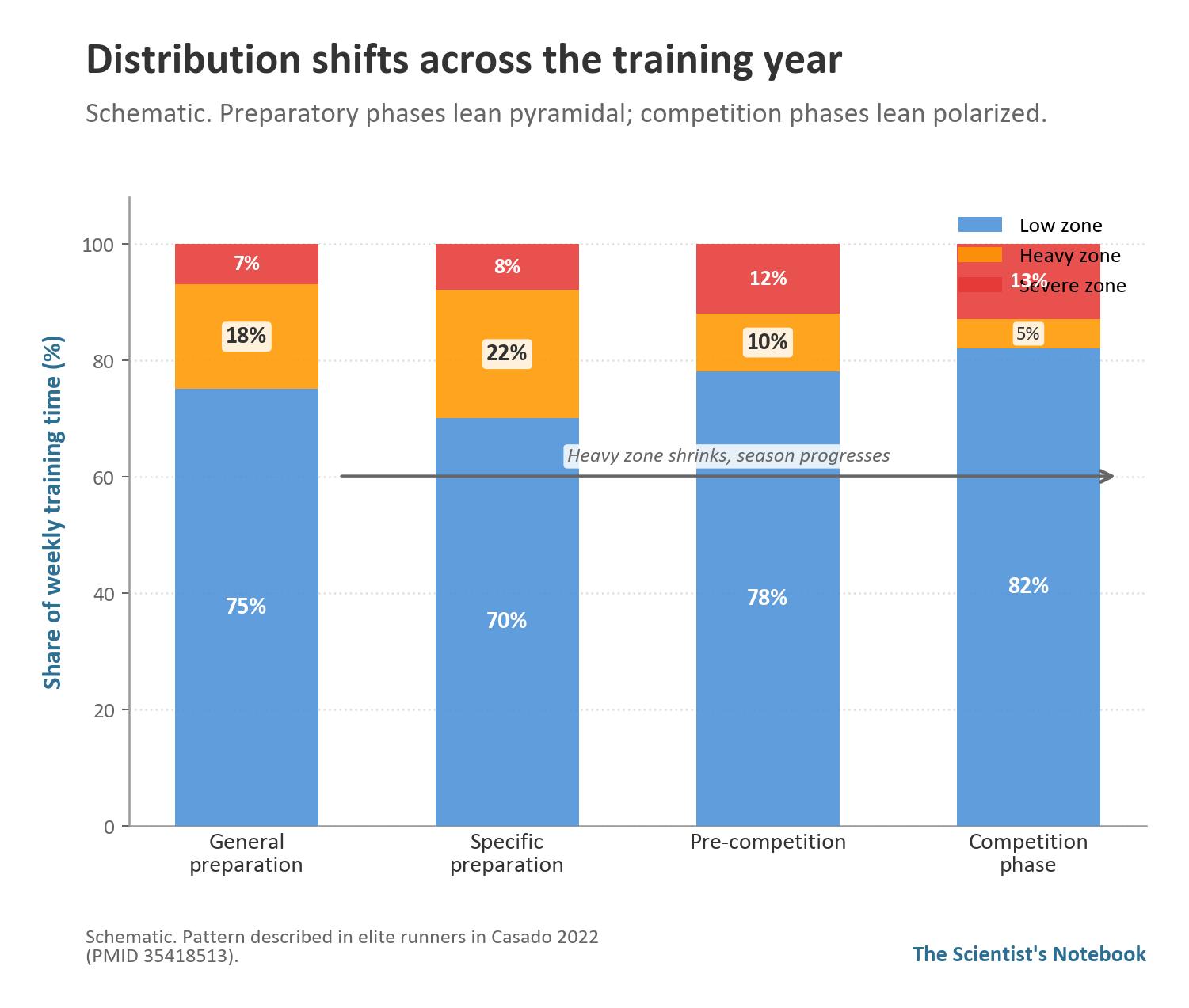
Reviews of distance runners observe that pyramidal shapes, which taper volume from a broad easy base through a moderate middle to a thin severe cap, are common and effective, particularly outside the final competition phase.
Direct trials that loaded the middle as the dominant stimulus, the classic threshold model, generally show smaller gains in well-trained athletes than either alternative, while in less-trained populations the middle zone retains more value.
Where athletes tend to land: Observational data on elite distance runners describe a frequent drift from pyramidal distributions during preparatory phases toward more polarized shapes as competition nears, with race-specific threshold work reappearing near key events.
The cohorts that fare worst tend to be those whose weeks collapse into a near-permanent emphasis on the heavy zone, where the middle stops being a phase-specific tool and becomes the whole program.
Lever 3: Athlete caliber and training phase
The data: The apparent superiority of any single distribution narrows sharply once caliber and phase are accounted for.
A network synthesis of individual participant data found no overall difference between polarized and pyramidal distributions for oxygen uptake or time-trial performance, but a subgroup signal suggested competitive athletes may gain more from polarized shapes and recreational athletes more from pyramidal ones.
Phase matters in parallel: preparatory blocks lean on volume and a fuller middle, while competition-proximal weeks shift toward sharper, more polarized profiles.
Where athletes tend to land: Higher-caliber athletes in the literature already perform large low-intensity volumes, so the marginal question for them is how to allocate the small hard fraction rather than whether to train easy at all.
Recreational and time-limited athletes land in a more heterogeneous place, where individual response, available hours, and event demands appear to matter as much as the distribution label.
Method and a worked example
Most of the evidence on intensity distribution comes from studies built on a recognizable common scaffold, and understanding that scaffold clarifies both what the findings mean and where they wobble.
Method
- Characterize each athlete with an incremental test to fix the two thresholds and the peak oxygen uptake, which set the boundaries of the three intensity zones for that individual.
- Assign athletes to distribution arms, typically a polarized arm and a threshold or pyramidal arm, matched as closely as possible for total training volume or total work so that only the shape differs.
- Prescribe and monitor sessions over a block of several weeks, controlling intensity by heart rate, power, or pace, and log the actual time accumulated in each zone to confirm the intended distribution was achieved.
- Retest the same performance and physiological markers afterward, peak power or velocity, threshold velocity, oxygen uptake, and time to exhaustion, under matched conditions.
- Compare pre-to-post changes between arms, accounting for the small sample sizes and short durations that characterize most of this literature.
A composite case
Consider a generic well-trained runner, unnamed, who enters a study assigned to the hollow-middle arm after years of training that leaned heavily on the moderate zone. In the first weeks the change feels almost like detraining.
Most sessions are slower than habit, the legs feel underused, and an early retest shows oxygen uptake essentially flat, which is discouraging and statistically unremarkable.
Around the midpoint a calf strain from an overzealous interval session forces a week of reduced load, the kind of non-linear interruption that rarely appears in the tidy summary tables.
The runner returns cautiously, keeping the easy volume genuinely easy this time and treating the sparse hard sessions with more respect.
Only in the final stretch of the block does the delayed payoff arrive: threshold velocity has climbed, the hard intervals that once felt ruinous now feel repeatable, and the post-test oxygen uptake lands meaningfully above baseline.
The arc is real but messy, an early dip, a mid-block setback, and a payoff that the block-average masks.
It is worth remembering that a single runner's trajectory, however clean it looks in retrospect, is one noisy draw from a distribution of responses, not proof that the shape caused the gain.
Where this leaves us
Stepping back from the individual levers, a coherent picture emerges, though it is quieter than the headlines suggest.
The strongest claim the evidence supports is comparative and conditional: when training volume is held constant in already-trained athletes, distributions that keep most work genuinely easy and concentrate the hard fraction at high intensity tend to match or beat distributions that load the moderate middle.
The weakest version of the claim, that one universal shape is optimal for everyone, does not survive contact with the data once athlete caliber and training phase are taken into account.
What ties the threads together is the idea that easy volume and hard volume do partly separate jobs, and that the moderate middle is expensive enough that spending the whole week there rarely pays.
That is why the elite cohorts converge on large easy bases regardless of label, why pyramidal and polarized shapes both outperform a permanent threshold emphasis in trained athletes, and why the choice between pyramidal and polarized appears to hinge on caliber and on where in the season the week sits rather than on a single decisive experiment.
Thomas Mortelmans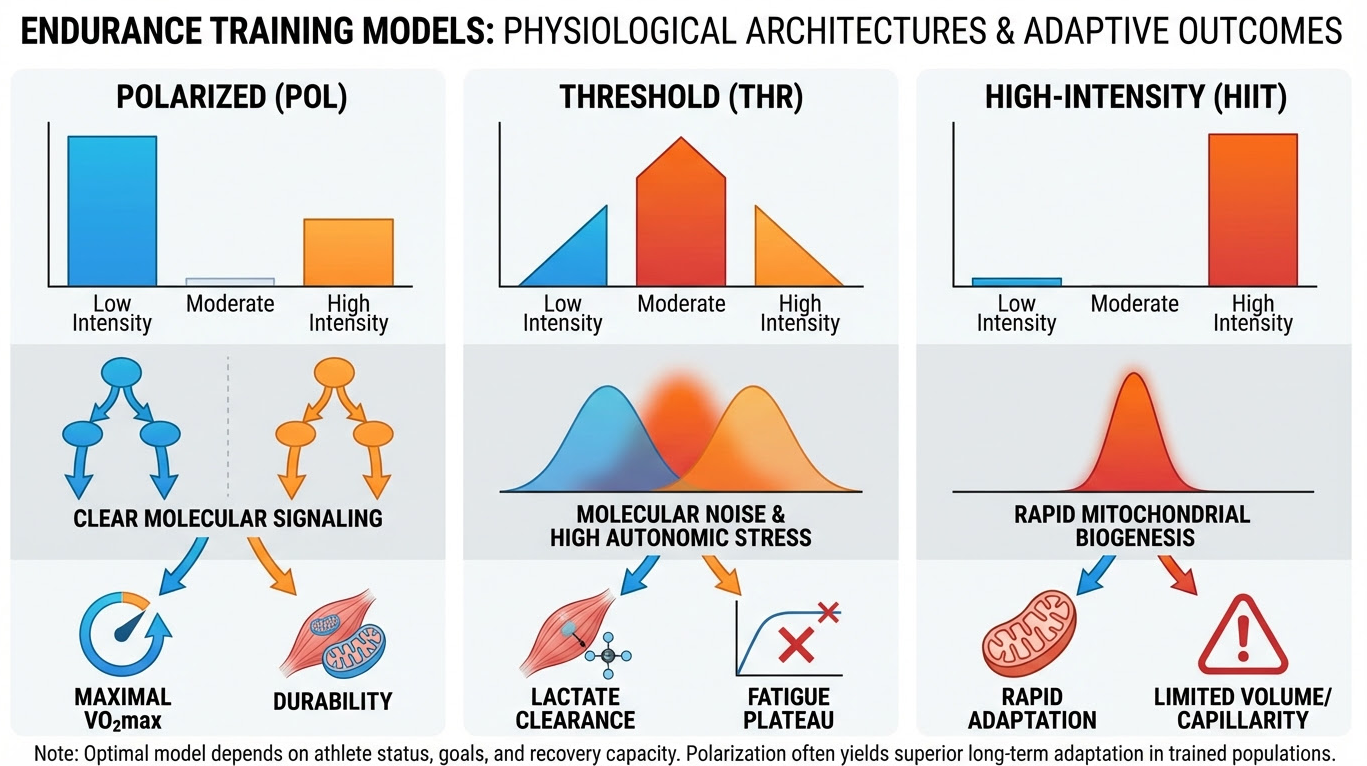
Related reading
The honest residual is large. The head-to-head trials are short, often a handful of weeks, and small, often a dozen or so athletes per arm, so they may understate slow adaptations and overstate noise.
And the deepest problem is definitional: labs draw the zone boundaries differently and count distribution differently, so the same training week can be classified as polarized by a session-goal method and pyramidal by a time-in-zone method, which makes pooling studies a genuine hazard rather than a formality.
Best regards,
Dr. Thomas Mortelmans
Limits of Application: The studies behind this entry skew toward healthy, mostly male, trained endurance athletes in running, cycling, skiing, and swimming, and their findings do not necessarily transfer to beginners, older athletes, women who remain underrepresented in this literature, or anyone managing illness or injury.
Intensity distribution is a descriptive lens on what researchers observed in those cohorts, not a prescription, and the inconsistent zone definitions and short interventions mean confidence intervals are wider than any single percentage implies.
This is an exploration of the physiology, not medical or coaching advice, and decisions about your own training should be made with qualified professionals who know your full context.
References
- Stoggl T, et al. Polarized training has greater impact on key endurance variables than threshold, high intensity, or high volume training. Front Physiol. 2014. PMID 24550842. In well-trained athletes a polarized distribution produced the largest gains in peak oxygen uptake, time to exhaustion, and peak velocity or power compared with threshold, high-intensity, or high-volume models.
- Neal CM, et al. Six weeks of a polarized training-intensity distribution leads to greater physiological and performance adaptations than a threshold model in trained cyclists. J Appl Physiol (1985). 2013. PMID 23264537. A matched-volume crossover in trained cyclists found larger improvements in peak power, threshold, and high-intensity capacity from the hollow-middle distribution than from a threshold-heavy one.
- Rosenblat MA, et al. Polarized vs. Threshold Training Intensity Distribution on Endurance Sport Performance: A Systematic Review and Meta-Analysis of Randomized Controlled Trials. J Strength Cond Res. 2019. PMID 29863593. Pooling the few qualifying trials, the analysis reported a moderate effect on time-trial performance favoring polarized over threshold distributions, with notable between-study heterogeneity.
- Rosenblat MA, et al. Which Training Intensity Distribution Intervention will Produce the Greatest Improvements in Maximal Oxygen Uptake and Time-Trial Performance in Endurance Athletes? A Systematic Review and Network Meta-analysis of Individual Participant Data. Sports Med. 2025. PMID 39888556. Across pooled individual data there was no overall difference between polarized and pyramidal distributions, but competitive athletes tended to respond better to polarized and recreational athletes to pyramidal shapes.
- Seiler KS, Kjerland GO. Quantifying training intensity distribution in elite endurance athletes: is there evidence for an "optimal" distribution? Scand J Med Sci Sports. 2006. PMID 16430681. Detailed quantification of well-trained skiers showed most training fell clearly below or substantially above the lactate-accommodation zone, with surprisingly little time spent at threshold.
- Casado A, et al. Training Periodization, Methods, Intensity Distribution, and Volume in Highly Trained and Elite Distance Runners: A Systematic Review. Int J Sports Physiol Perform. 2022. PMID 35418513. Elite distance runners commonly followed a pyramidal distribution in preparation that shifted toward a more polarized profile during the competition phase.
- Campos Y, et al. Training-intensity Distribution on Middle- and Long-distance Runners: A Systematic Review. Int J Sports Med. 2021. PMID 34749417. The review documented that different quantification methods yield different zone counts and that high-volume, low-intensity distributions outperformed threshold-dominant ones for endurance performance.
- Kenneally M, et al. The Effect of Periodization and Training Intensity Distribution on Middle- and Long-Distance Running Performance: A Systematic Review. Int J Sports Physiol Perform. 2018. PMID 29182410. Pyramidal and polarized distributions were both more effective than threshold training, and the authors highlighted race-pace-based zone definitions as a way to reconcile the models.
- Coates AM, et al. A Perspective on High-Intensity Interval Training for Performance and Health. Sports Med. 2023. PMID 37804419. A conceptual review noting that high-intensity interval training lacks a standardized definition and is best characterized relative to physiological intensity domains in performance contexts.
- Laursen PB, Jenkins DG. The scientific basis for high-intensity interval training: optimising training programmes and maximising performance in highly trained endurance athletes. Sports Med. 2002. PMID 11772161. In already-trained athletes additional low-intensity volume alone tends not to raise performance, so improvements often depend on adding high-intensity interval work.
- Helgerud J, et al. Aerobic high-intensity intervals improve VO2max more than moderate training. Med Sci Sports Exerc. 2007. PMID 17414804. Matched for total work, aerobic high-intensity intervals raised maximal oxygen uptake and stroke volume more than long slow distance or threshold-intensity training.
- Hov H, et al. Aerobic high-intensity intervals are superior to improve VO2max compared with sprint intervals in well-trained men. Scand J Med Sci Sports. 2022. PMID 36314990. Four-minute aerobic intervals improved oxygen uptake and stroke volume more than short sprint-interval protocols, illustrating how interval structure shapes the adaptation.
- Wen D, et al. Effects of different protocols of high intensity interval training for VO2max improvements in adults: A meta-analysis of randomised controlled trials. J Sci Med Sport. 2019. PMID 30733142. Across fifty-three trials, even short, low-volume, short-term interval protocols produced meaningful oxygen-uptake gains, with longer-interval, higher-volume formats yielding the largest effects.
- Molmen KS, et al. Effects of Exercise Training on Mitochondrial and Capillary Growth in Human Skeletal Muscle: A Systematic Review and Meta-Regression. Sports Med. 2024. PMID 39390310. Sprint and interval training increased mitochondrial content more efficiently per hour, while sustained lower-intensity training favored capillary density, underscoring that easy and hard work drive partly different adaptations.
- Burnley M, et al. Polarized Training Is Not Optimal for Endurance Athletes. Med Sci Sports Exerc. 2022. PMID 35135998. A counterpoint perspective arguing that the polarized model is not universally optimal and that threshold and pyramidal approaches retain value depending on athlete and event.
---
If you have 60 seconds, I would value your anonymous feedback. You can share it here.
---
Health disclaimer
This post discusses endurance-training science for educational purposes. It is not medical advice, not a diagnosis, and not a substitute for clinical care. Individual response to training, sleep deprivation, and multi-day exertion varies substantially, and what applies to a research cohort or a world-class athlete may not apply to you. Consult a qualified physician, sports medicine specialist, or registered dietitian before changing your training, fuelling, or sleep strategy if you have a cardiovascular, metabolic, psychiatric, or sleep-related condition; are recovering from injury or illness; are pregnant; are on medication that affects heart rate, hydration, glucose regulation, or sleep; or have concerns about exercise tolerance. Ultra-endurance events impose real physiological and psychological loads. Persistent chest pain, fainting, acute confusion beyond the predictable late-race window, severe dehydration, sustained loss of coordination, or any mental-health symptoms that outlast the immediate post-event dip warrant professional care and are not signals to push through. No outcome is guaranteed. The protocols, anchors, and case material in this post are descriptive, drawn from peer-reviewed evidence and a guest contributor's lived experience, and should be treated as inputs to an informed conversation with your own coach and clinicians, not as prescriptions.
Keep going
Paces derived from current fitness rather than a target time are the ones that hold up. Gradescale computes your easy, threshold and interval paces from a recent result.
Training plans built on the same evidence base:
Thomas MortelmansJoin our Discord community:
Thomas Mortelmans