
Entry #044: Detraining: What You Lose, How Fast, and What Sticks
Take three weeks off and something strange happens. The hills feel steeper, your heart rate runs higher at the same pace, and the engine you spent a year building seems to have quietly shrunk.
Yet a fellow athlete who took the same break swears they came back almost untouched.
Both stories can be true, because detraining is not one process. It is a stack of separate clocks, each ticking at its own speed.
The physiology of fitness is a set of distinct adaptations layered on top of each other.
Your blood volume, your heart's filling capacity, the density of mitochondria inside your muscle cells, the web of capillaries feeding them, and the neural patterns that fire your fastest fibers all carry training memory. They also forget it at very different rates.
Some begin to fade within days. Some hold their ground for months.
A few seem almost stubborn, lingering well above an untrained baseline long after the obvious fitness has gone.
This matters because the off-season, an injury layoff, a busy stretch at work, or a forced illness break are not abstract.
They are the real texture of an athletic life, and the literature on what happens during those breaks is unusually detailed.
Researchers have tracked trained people across days, weeks, and months of stopping, measured their hearts and their muscle enzymes, and even infused a dextran solution back into detrained athletes to see which losses reverse on command.
 Thomas Mortelmans
The picture that emerges is more reassuring, and more specific, than the folk wisdom of use it or lose it suggests.
This entry maps that picture. We will walk through what decays first, what proves durable, why highly trained athletes have both more to lose and a deeper reserve to protect, and how a planned reduction in training differs from a full stop.
The goal is not a prescription. It is a clearer mental model of what is actually happening under the skin when the training stops.
The numbers in this piece are the kind Gradescale computes from your own rides and runs, with the working shown.
The brief
- Different systems decay at different speeds. Detraining is not a single downhill slide. Blood volume, cardiac filling, oxidative enzymes, capillaries, and neuromuscular qualities each follow their own timeline, and lumping them together hides the most useful detail.
- Plasma volume falls first, and it falls fast. Within the first few weeks of stopping, the liquid portion of blood contracts by up to about twelve percent. With less blood to fill the heart, stroke volume drops, and that early loss explains much of the first dip in maximal oxygen uptake.
- Maximal oxygen uptake erodes over weeks, not days. In trained athletes, reported losses range from about four to fourteen percent within the first four weeks of full cessation and about six to twenty percent across longer layoffs, with the steepest declines in the most highly trained.
- Mitochondrial machinery declines on a multi-week clock. Oxidative enzyme activity in muscle drops with a half-life near twelve days, which is why fuel use shifts toward carbohydrate and lactate appears earlier at the same effort.
- Some adaptations are remarkably durable. Muscle capillary density and a portion of oxidative enzyme activity can sit well above untrained levels even after twelve weeks off. Strength and the neural skill behind it hold for weeks, and in several strength studies maximum strength was still above pre-training levels months later.
- Reduced training is a different animal than full cessation. Cutting volume sharply while keeping intensity has preserved maximal oxygen uptake for months in controlled studies, mostly of recently trained young adults. The variable that protects fitness is intensity, not mileage.
- Training history buys insurance. A long-trained athlete detrains to a higher floor than a recently trained one, who can lose almost all of a freshly built gain. The deep base is the part that resists reversal.
The science at a glance
Detraining is the partial loss of training adaptations when the stimulus that built them falls away.
The body maintains expensive machinery only while it is being used, so when the demand disappears, resources are reallocated and the adaptations regress. The useful insight is that this regression is not uniform.
Three principles capture most of what athletes need to understand.
Foundational Principle 1: The blood goes first
The earliest and most dramatic change after stopping is a drop in blood volume, driven mainly by a contraction of plasma, the watery fraction that training expands to support circulation.
Measurable reductions can begin within days, and within two to four weeks plasma volume can fall by up to about twelve percent.
The consequence is mechanical and immediate. With less blood returning to the heart, the chamber fills less completely, so stroke volume falls.
To deliver the same oxygen, heart rate climbs at every intensity, which is why a familiar pace suddenly costs more beats.
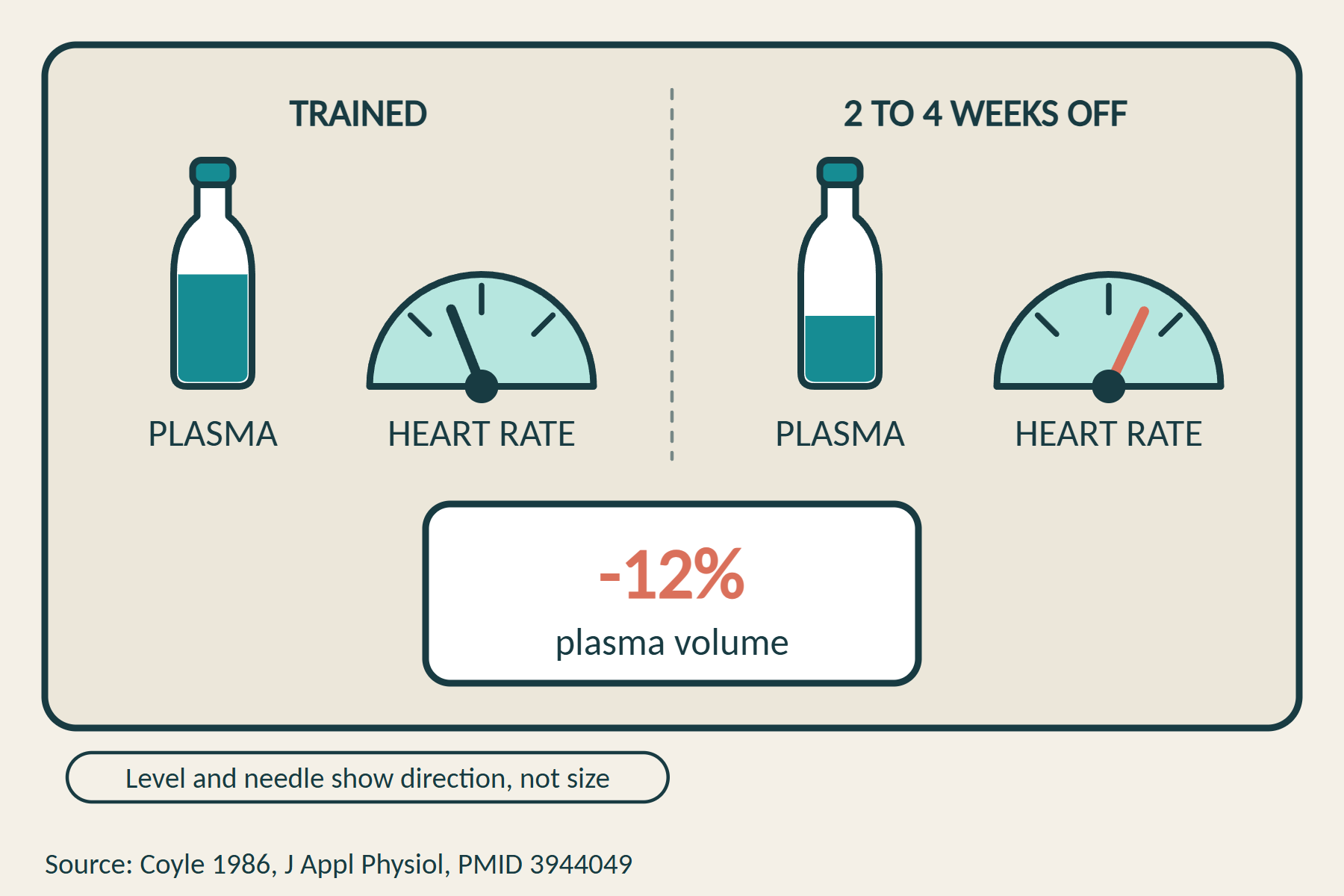
A classic demonstration infused fluid back into detrained athletes and watched much of their cardiovascular function return at once, which pinned the early loss largely on blood volume rather than on any deeper damage.
Scientist's Insight: In these studies, a higher heart rate at the usual pace after a layoff pointed to a half-empty fuel line, a smaller blood volume, more than to a breaking engine. Blood volume is also, in general, one of the quicker adaptations to return once training resumes.
Foundational Principle 2: The mitochondria fade on a slower clock
Deeper inside the muscle, the oxidative machinery follows a different and slower trajectory.
Citrate synthase, a workhorse enzyme of aerobic metabolism, declines with a half-life of about twelve days, meaning roughly half of its eventual drop has happened within about two weeks of full cessation, with further losses accumulating over the following weeks before activity levels off above untrained levels.
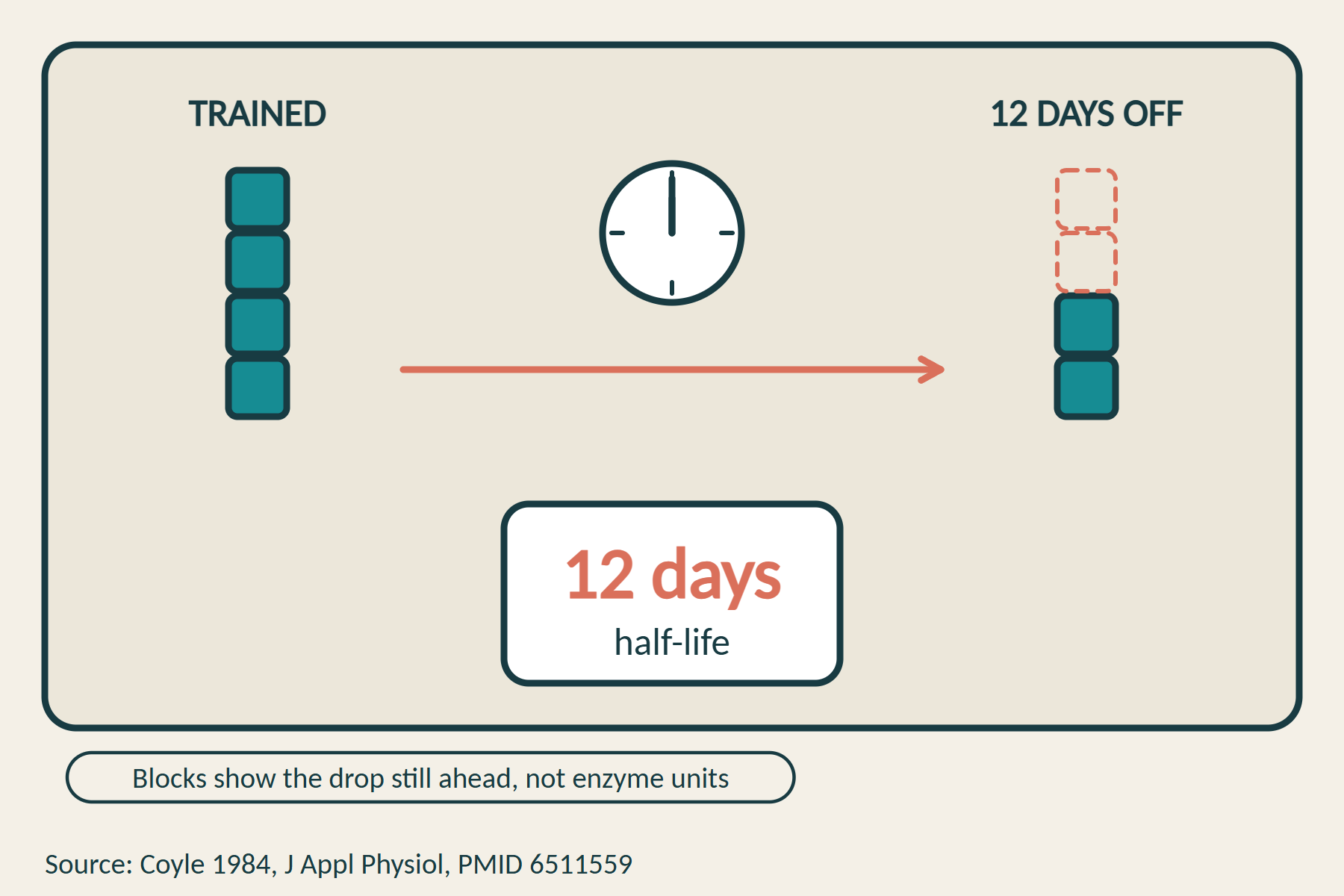
As this aerobic capacity thins, the working muscle leans harder on carbohydrate and produces lactate earlier at a given effort, and fat becomes a less accessible fuel.
This is the metabolic layer of detraining, and its timeline explains a puzzle: maximal oxygen uptake can dip quickly from the blood-volume effect, yet the muscle's true oxidative decline plays out over a longer span.
Across studies of trained athletes, maximal oxygen uptake losses of about four to fourteen percent within four weeks widen to roughly six to twenty percent over longer layoffs.
Scientist's Insight: The first drop in your aerobic ceiling is cardiovascular plumbing. The slower, grinding part is metabolic, written into the enzymes themselves, and it takes weeks of consistent work to rebuild.
Foundational Principle 3: The trained have more to lose, and more in reserve
Detraining is not symmetric across athletes. A highly trained endurance athlete tends to lose a larger absolute slice of maximal oxygen uptake during a long layoff than a recently trained one, partly because their high ceiling depends on sustaining high training loads.
Thomas Mortelmans
Yet the same athlete detrains to a higher floor. In one detailed time course of seven endurance-trained people, capillary density remained around fifty percent above untrained levels even after roughly twelve weeks off, and a portion of oxidative enzyme activity holds a similar surplus.
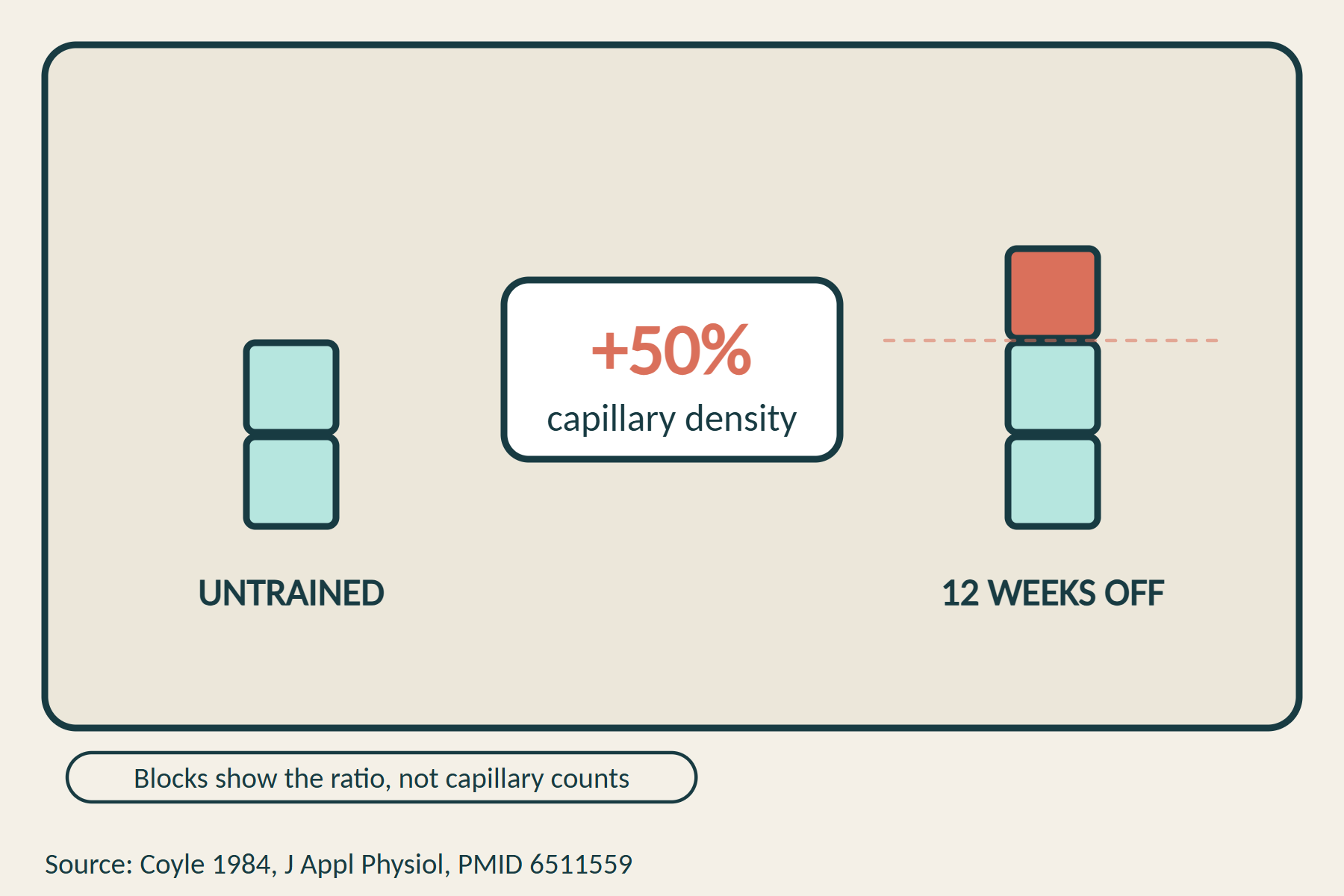
A recently trained person, by contrast, can see a freshly built gain reverse almost entirely. The durable layer is the deep base, the structural and cellular residue of years rather than weeks.
Capillaries, once laid down, are slow to disappear, and strength leans on neural skill that lingers well past the loss of muscle size.
Scientist's Insight: A long training history does not stop the loss. It changes where the loss ends: in long-trained endurance athletes, capillaries and part of the enzyme surplus were still above untrained levels months later, and these figures describe groups, not any one person.
Reading the signals
The research does not hand athletes a rulebook, but it does describe where different qualities tend to land over a layoff.
Three observational levers organize the evidence, each describing what the data show rather than advice.
The cessation lever: what a full stop does, and when
The data: In fully stopped, highly trained athletes, the steepest changes arrive early and then flatten.
In one detailed time course of seven endurance-trained people, maximal oxygen uptake fell about seven percent across the first three weeks and settled near sixteen percent below trained values after eight weeks, while muscle capillarization stayed elevated and oxidative enzymes leveled off above untrained levels.
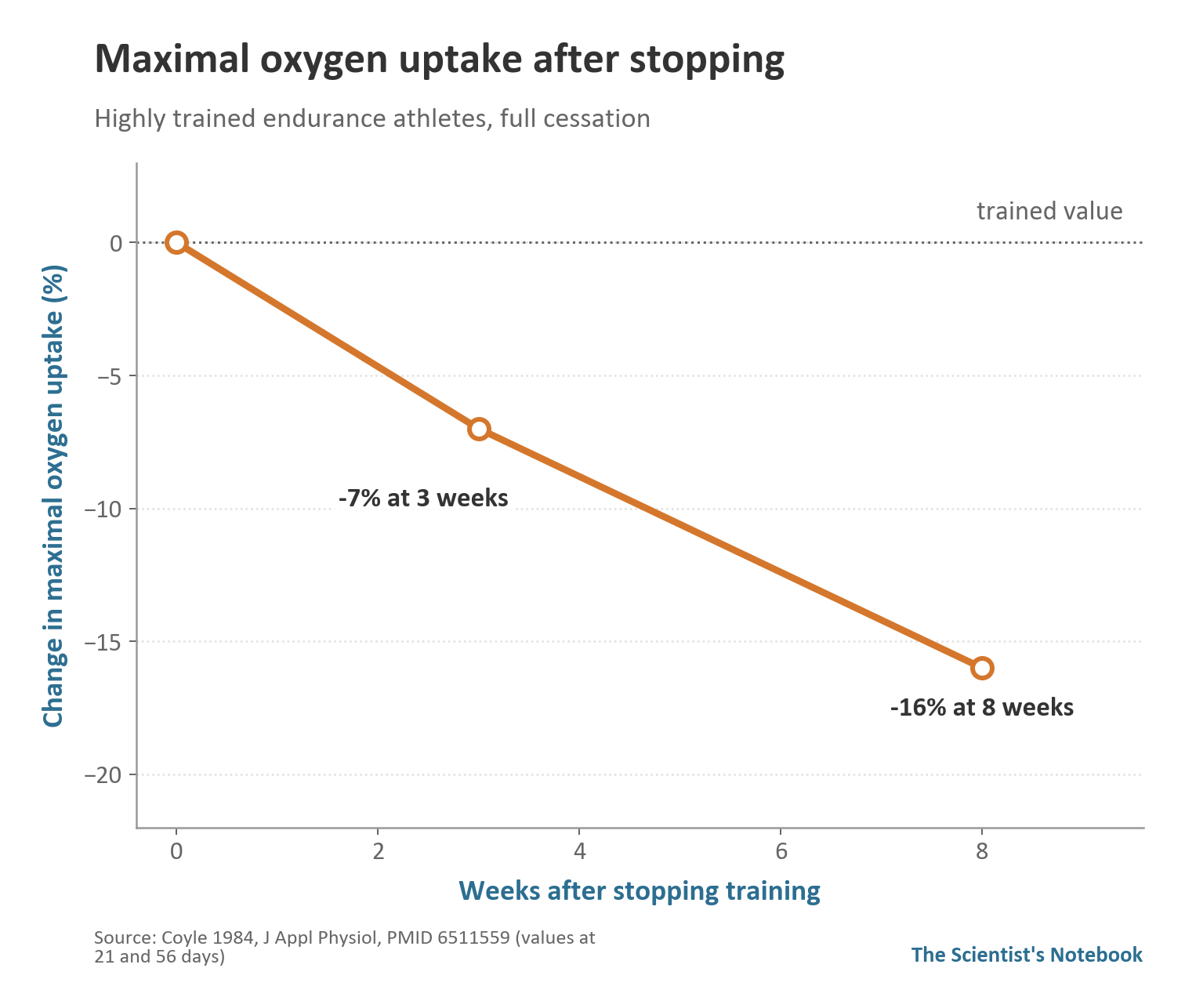
Where athletes tend to land is a curve, not a cliff: a fast cardiovascular drop in the first weeks, then a slower metabolic erosion.
Across the reviewed studies, layoffs of under four weeks track losses of about four to fourteen percent in highly trained athletes and more moderate losses in recently trained people, while longer layoffs of more than a month track losses of roughly six to twenty percent, with the largest declines among the most trained.
The reduced-training lever: what changes when volume falls and intensity stays
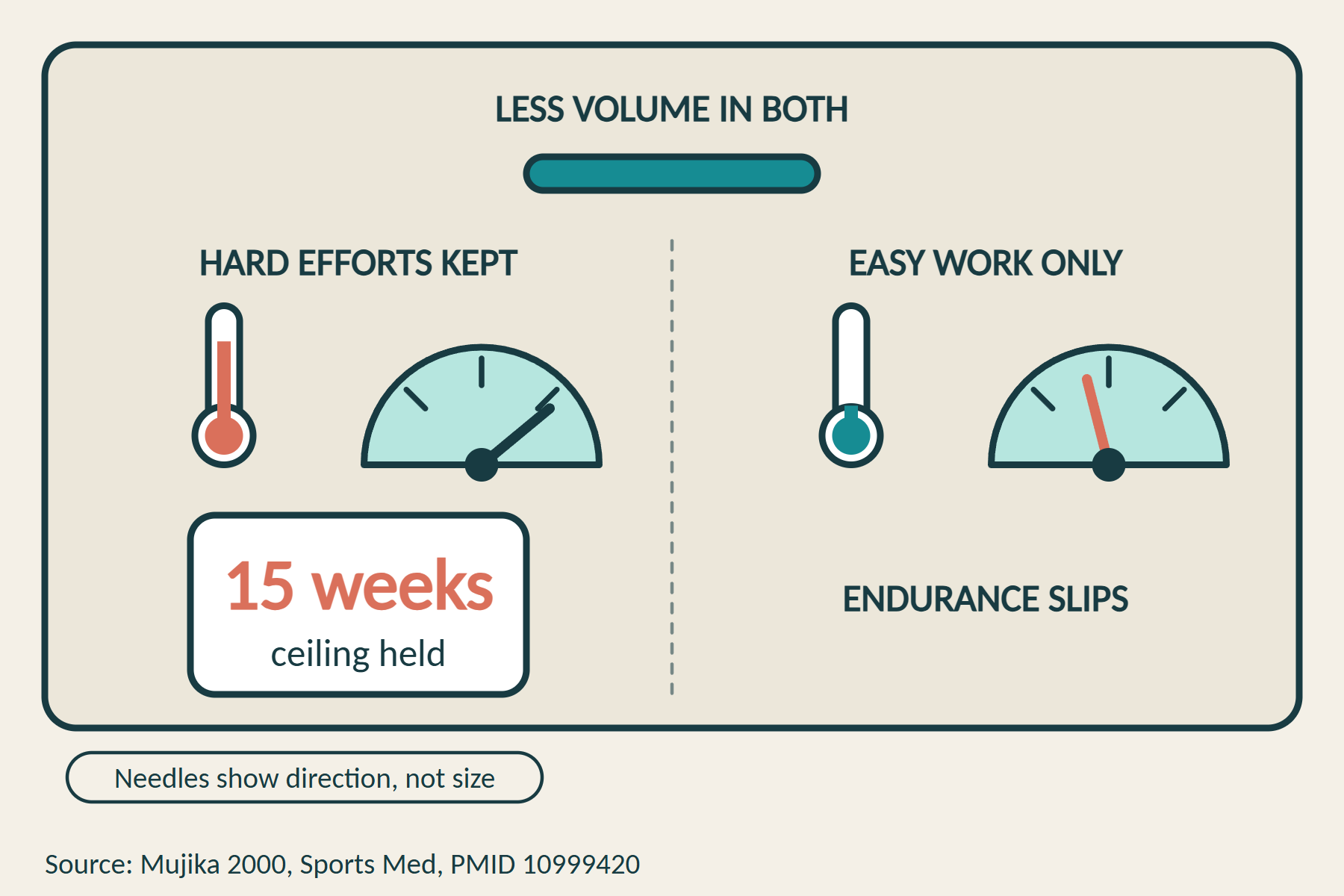
The data: Cutting volume is not the same as stopping. In classic work, recently trained young adults who cut training frequency by up to two thirds yet held intensity high maintained maximal oxygen uptake for fifteen weeks.
Where reduced-training athletes tend to land depends almost entirely on intensity: programs that preserved hard efforts protected the aerobic ceiling even when total volume fell sharply, whereas dropping to light, low-intensity work let endurance and metabolic function slip.
The literature on tapering points the same way. In a meta-analysis of competitive athletes, performance improved when volume was reduced substantially while intensity and frequency were largely preserved over about two weeks.
The signal across both bodies of work is that intensity is the load-bearing variable.
The tissue-specific lever: which tissues forget fast and which hold on
The data: Not all tissues read the same clock. In people who had completed nine to twelve weeks of resistance training, many of them older adults, maximum strength remained above pre-training levels after twelve weeks and even longer layoffs, with the neural component proving especially durable, even as muscle cross-sectional area regressed faster.
Capillary density and a share of oxidative enzymes held well above untrained baselines across months.
Cardiac structure tells a two-sided story: in forty elite male athletes, left ventricular wall thickness returned to normal after one to thirteen years of deconditioning while about one in five retained substantial chamber enlargement.
Where tissues tend to land, in short: plasma volume and stroke volume reverse quickly, oxidative enzymes fade over weeks, and capillaries, neural skill, and the deep structural base resist for far longer.
Method and a worked example
Understanding detraining means understanding how it is measured, because two very different study designs sit behind the numbers.
How the studies measured it
- Full cessation designs. Trained participants stop structured training entirely. Researchers then test them at fixed intervals, in the classic time course at days twelve, twenty-one, fifty-six, and eighty-four, measuring maximal oxygen uptake, stroke volume, blood and plasma volume, and muscle samples for enzyme activity and capillary density. This design isolates the natural decay curve of each system with no confounding stimulus, which is why it produced the cleanest half-life estimates for oxidative enzymes and the clearest early role of blood volume.
- Reduced-training designs. Participants train up, then shift to a lower load while one variable is deliberately held or cut. Some studies hold intensity and slash frequency or volume; others reduce intensity itself. By comparing arms, these designs reveal which lever protects fitness. The recurring finding is that intensity preservation defends the aerobic ceiling while volume can be cut sharply, and that light, easy work alone tends to let endurance qualities slide.
- Infusion and imaging probes. A smaller set of studies expanded blood volume in detrained athletes with fluid, or imaged the heart before and after deconditioning. These isolated specific mechanisms, confirming that early cardiovascular loss is largely a blood-volume effect and that cardiac remodeling partly, though not fully, reverses.
A composite case: a runner's four weeks off
Consider a generic recreational runner who takes four weeks completely off after a hard season. The first week feels like freedom, and almost nothing seems different.
Yet by the end of that week plasma volume has already begun contracting, so the first run back in week two carries a heart rate that sits higher than memory expects at an easy pace.
This is the non-linear reality: the felt change lags the physiological one, then arrives abruptly.
Through weeks two and three the oxidative machinery quietly thins, and lactate shows up earlier on the first tempo effort, which feels discouraging out of proportion to the time elapsed.
By week four, going by the group data, the maximal oxygen uptake loss for a runner like this would most likely sit in the single digits rather than anything dramatic, and crucially, the capillaries feeding those muscles are likely still well above untrained levels and the neural patterns of the stride largely intact.
The deep base built over years has likely moved far less.
The recovery curve is not the mirror image of the loss curve: blood volume tends to refill within days to weeks, while the oxidative enzymes that faded over weeks ask for a similar span of consistent work to return.
For a runner like this, the early high heart rate fits a refilling fuel line better than a vanished engine.
Where this leaves us
Detraining rewards a layered view. The blood-volume clock runs in days, the mitochondrial clock in weeks, and the structural and neural clocks in months.
A planned reduction that keeps intensity is a fundamentally different event than a full stop, and a deep training base is the part that resists reversal most stubbornly.
Thomas Mortelmans
Read together, the evidence suggests that an off-season is far less catastrophic than the first high-heart-rate run back tends to feel.
Best regards, Dr. Thomas Mortelmans
Limits of Application: The numbers here are central tendencies drawn from heterogeneous studies, many of them small, with mixed populations spanning recreational exercisers, elite endurance athletes, resistance-trained adults, and older participants.
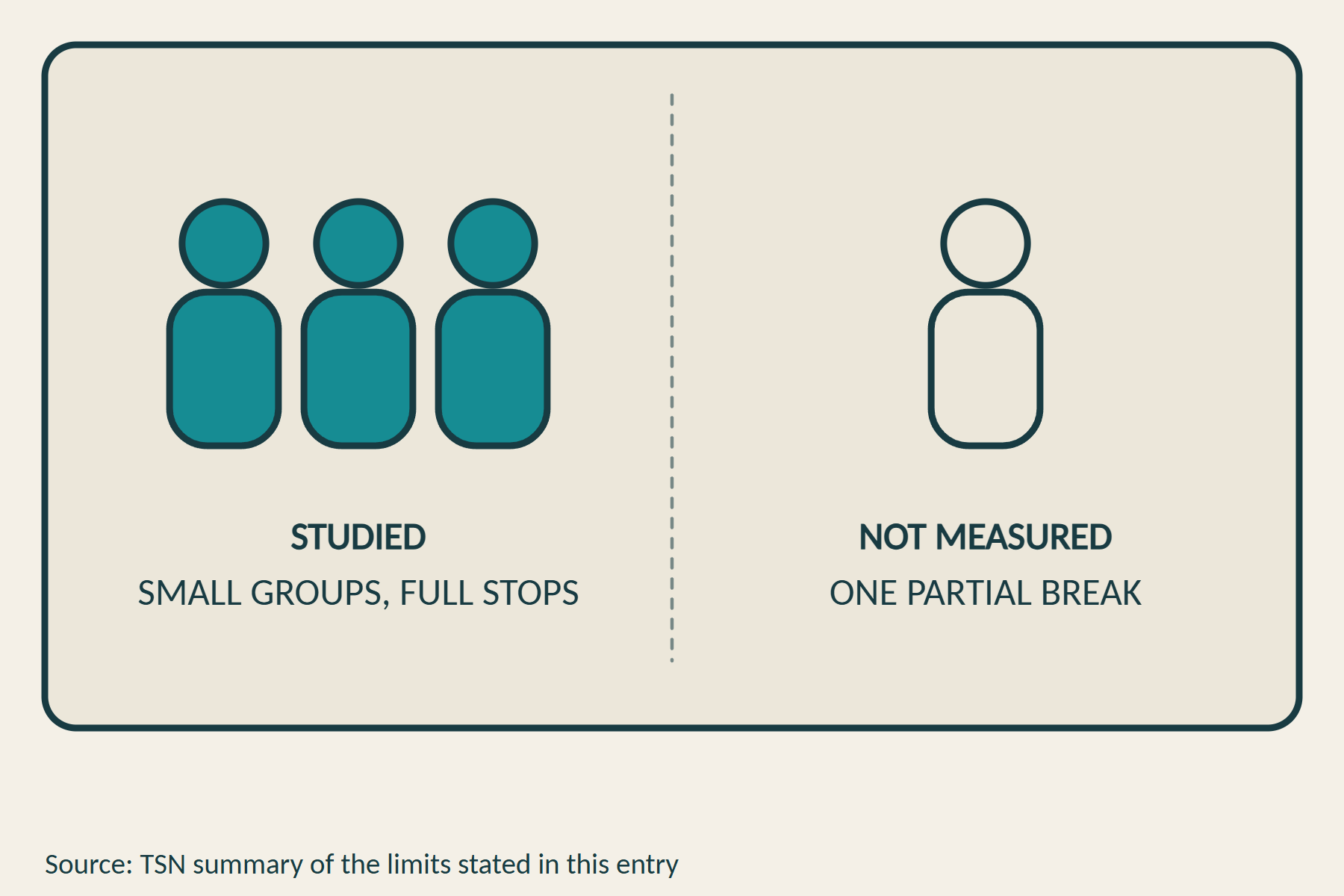
Decay rates vary with training history, age, sport, sex, and the exact definition of detraining used, so any single figure is a signpost rather than a personal forecast.
Much of the cleanest mechanistic work comes from small samples and short windows, and laboratory cessation rarely matches the messy partial breaks of real life.
This entry describes what the literature observes about populations; it is not medical, clinical, or individualized coaching guidance, and it does not account for injury, illness, or specific health conditions that change the calculus entirely.
References
- Mujika I, Padilla S. Detraining: loss of training-induced physiological and performance adaptations. Part I: short term insufficient training stimulus. Sports Med. 2000. PMID 10966148. Foundational review showing rapid early declines in maximal oxygen uptake and blood volume during short-term cessation, with metabolic shift toward carbohydrate use.
- Mujika I, Padilla S. Detraining: loss of training-induced physiological and performance adaptations. Part II: long term insufficient training stimulus. Sports Med. 2000. PMID 10999420. Companion review establishing that long-term losses are larger but stay above untrained values in the highly trained, and that intensity-preserving reduced training limits the damage.
- Coyle EF, Martin WH, Sinacore DR, et al. Time course of loss of adaptations after stopping prolonged intense endurance training. J Appl Physiol. 1984. PMID 6511559. The classic time course: maximal oxygen uptake fell 7% in 21 days then stabilized at 16% below trained, while capillaries and oxidative enzymes stayed 50% above sedentary.
- Coyle EF, Hemmert MK, Coggan AR. Effects of detraining on cardiovascular responses to exercise: role of blood volume. J Appl Physiol. 1986. PMID 3944049. Infusion study pinning the early stroke-volume and maximal oxygen uptake loss on reduced blood and plasma volume, reversed by expanding volume.
- Mujika I, Padilla S. Muscular characteristics of detraining in humans. Med Sci Sports Exerc. 2001. PMID 11474330. Review of muscle-level detraining: declining oxidative enzymes and arterial-venous oxygen difference, with capillary and fiber changes on distinct timelines.
- Psilander N, Eftestol E, Cumming KT, et al. Effects of training, detraining, and retraining on strength, hypertrophy, and myonuclear number in human skeletal muscle. J Appl Physiol. 2019. PMID 30991013. In 9 men and 10 women, 10 weeks of one-leg strength training raised strength about 20%; after 20 weeks of detraining, muscle size was back to baseline while strength stayed elevated, which the authors read as a long-lasting motor-learning effect.
- Blocquiaux S, Gorski T, Van Roie E, et al. The effect of resistance training, detraining and retraining on muscle strength and power, myofibre size, satellite cells and myonuclei in older men. Exp Gerontol. 2020. PMID 32017951. Detraining caused only modest strength and power loss in older men, with partial preservation enabling rapid retraining.
- Sakugawa RL, Moura BM, Orssatto LBR, et al. Effects of resistance training, detraining, and retraining on strength and functional capacity in elderly. Aging Clin Exp Res. 2019. PMID 29777475. After 16 weeks of detraining, maximum strength stayed above baseline and recovered quickly with brief retraining.
- Tokmakidis SP, Kalapotharakos VI, Smilios I, et al. Effects of detraining on muscle strength and mass after high or moderate intensity of resistance training in older adults. Clin Physiol Funct Imaging. 2009. PMID 19302225. Strength and muscle area declined with detraining but remained above pre-training, with higher-intensity training leaving a higher residual level.
- Lemmer JT, Hurlbut DE, Martel GF, et al. Age and gender responses to strength training and detraining. Med Sci Sports Exerc. 2000. PMID 10949019. Strength was retained equally well in men and women, with younger adults losing less (8%) than older adults (14%) over 31 weeks of detraining.
- Bosquet L, Montpetit J, Arvisais D, Mujika I. Effects of tapering on performance: a meta-analysis. Med Sci Sports Exerc. 2007. PMID 17762369. Reducing volume by 41 to 60% over two weeks while holding intensity and frequency optimized performance, underscoring intensity as the protected variable.
- Vachon A, Berryman N, Mujika I, et al. Effects of tapering on neuromuscular and metabolic fitness in team sports: a systematic review and meta-analysis. Eur J Sport Sci. 2021. PMID 32172680. Across 14 studies of team-sport athletes, tapering improved maximal power, maximal oxygen uptake, change-of-direction speed and repeated-sprint ability, though too few studies compared taper strategies to rank them.
- Clemente FM, Ramirez-Campillo R, Sarmento H. Detrimental Effects of the Off-Season in Soccer Players: A Systematic Review and Meta-analysis. Sports Med. 2021. PMID 33400214. Across 12 studies of male soccer players, training cessation worsened maximal oxygen uptake and repeated-sprint ability more than structured off-season programs, which blunted but did not prevent those losses.
- Olah A, Kellermayer D, Matyas C, et al. Complete Reversion of Cardiac Functional Adaptation Induced by Exercise Training. Med Sci Sports Exerc. 2017. PMID 27755352. A rat study (16 animals): swim-training-induced left ventricular hypertrophy and its functional gains regressed fully to control values after eight weeks of deconditioning.
- Pelliccia A, Maron BJ, De Luca R, et al. Remodeling of left ventricular hypertrophy in elite athletes after long-term deconditioning. Circulation. 2002. PMID 11864923. In 40 elite male athletes followed over 1 to 13 years of detraining, wall thickness normalized, but substantial chamber enlargement persisted in over 20%, showing partial rather than total cardiac reversal.
If you have 60 seconds, I would value your anonymous feedback. You can share it here.
Health disclaimer
This entry summarizes what studies found about how fitness changes when training stops or shrinks. It describes research, not a plan for you, and the studies were mostly small and drawn from specific groups such as endurance athletes, soccer players and older adults. Individual responses differ, and these findings are group averages, not a timeline for your own return to training. Not medical advice.
Keep going
These are the numbers Gradescale computes from your own rides and runs, with the working shown.
Training plans built on the same evidence base:
Thomas MortelmansJoin our Discord community:
Thomas Mortelmans